
Combining Gum Contouring with Veneers: A Thoughtful Guide to Smile Design

What if a smile looks uneven not because the teeth alone need changing, but because the gum line frames them differently? Patients considering combining gum contouring with veneers often want to know whether both are necessary and which should come first. The answer depends on what is shaping the concern, not on a standard package.
In my clinical experience, gum contouring and veneers address distinct features. Gum contouring may reshape excess or uneven gum tissue, while veneers alter the visible form, shade or proportions of selected teeth. Sometimes one treatment is enough. A balanced result also depends on gum health, the condition of the natural teeth and how the teeth meet when you bite. These factors matter for comfort and function, not only appearance.
In this guide, I explain how the treatments may be planned together, when one may be sufficient, and how clinical findings influence suitability and treatment order. A conservative, individualised smile design starts with careful diagnosis. Understanding what each procedure can address helps you discuss what your smile genuinely needs.
Table of Contents
Why consider combining gum contouring with veneers?
Teeth can appear uneven, short or out of proportion even when the concern is not limited to their visible surfaces. An irregular gum line may make one tooth look smaller than its neighbour, while differences in tooth shape or shade can affect the balance of a smile in another way. Patients often notice the overall impression before identifying which feature is contributing to it.
Combining gum contouring with veneers means considering gum display and visible tooth appearance together as part of a coordinated smile plan. It does not mean both treatments are automatically needed. My aim is harmony, not adding procedures for their own sake. I assess the tissues, teeth and bite, then consider whether either treatment is appropriate and whether a combined approach would address the concern without treating more than necessary.
The gum line shapes the frame of the smile; veneers can refine the visible surfaces of selected teeth. Keeping those roles distinct clarifies what each procedure may contribute and where its limits lie.
What gum contouring changes in a smile
Gum contouring may reshape the visible gum line when uneven gum display affects how the teeth appear. For example, if the gum margin sits differently across neighbouring teeth, their visible proportions may seem less balanced. A gum lift (gingivectomy) is one term used for procedures involving gum tissue, although the appropriate approach depends on the individual diagnosis.
Aesthetic contouring is not a substitute for assessing active gum disease. If the gums are inflamed, bleeding or otherwise unhealthy, that concern needs clinical attention before aesthetic treatment is considered. Examination helps establish whether the gum line can be reshaped appropriately and whether the appearance relates to the gums, tooth proportions or another factor.
What veneers can change, and what they cannot
Veneers are restorations placed on selected visible tooth surfaces. Depending on the tooth and treatment plan, they may alter characteristics such as apparent shape, shade or proportions. Their role is to refine the appearance of the teeth themselves, rather than reshape the gum tissue around them.
Veneers do not correct every concern. They cannot, by themselves, change an uneven gum line or resolve every bite issue. Nor are they suitable for every tooth or patient. The condition of the teeth, gum health, bite and individual goals all inform whether veneers are appropriate. This is where precision matters: choosing a restoration before understanding the cause of the imbalance may leave the patient’s main concern unaddressed.
In my clinical experience, the useful question is not simply whether both treatments can be combined. It is whether each proposed step has a clear purpose. Smile design should respond to a person’s anatomy and priorities while accounting for oral health and function. That distinction helps patients have a more informed discussion about what may be appropriate and what may not be needed.
How gum contouring and veneers complement one another
A gum line can change how much of each tooth is visible, which affects how the teeth look in relation to one another. If one tooth seems shorter, the cause may relate to its visible gum margin, its shape or a combination of factors. I assess the frame and the teeth together because changing one can alter how the other is perceived.
Gum position and tooth proportions need to be considered together because each influences the balance of the smile. The comparison below shows how their roles differ and why examination matters before choosing a treatment.
When the gum line is the main concern
Uneven gum display may make adjacent teeth look different in length, but appearance alone cannot establish whether contouring is appropriate. I examine the gum tissues and their health, consider how the margins relate to the teeth, and assess what may be contributing to the concern. That diagnosis guides whether aesthetic planning can proceed and which options may be suitable.
When tooth shape or colour is the main concern
A veneer assessment considers the visible features a patient hopes to refine, alongside the condition of the tooth and its enamel. I also consider the bite, since appearance should sit comfortably within function. Readers interested in how appearance and function inform a broader approach can explore cosmetic dentistry and functional aesthetics as a related topic.
With combining gum contouring with veneers, the order depends on the individual findings and intended design. In some plans, gum position needs to be assessed before finalising tooth proportions; in others, contouring may not be indicated. I do not apply a fixed sequence without first understanding the tissues, teeth and bite.
A considered smile-design discussion can clarify which concern is driving the imbalance and whether one or both approaches have a meaningful role. An individual smile-design discussion can centre on oral health, priorities and function.
Does combining gum contouring with veneers risk overtreatment?
Not automatically. Planning both procedures does not mean both are necessary, and choosing one does not make the plan more appropriate by default. The decision should respond to examination findings, what you hope to change, and what will support your oral health and bite. Sometimes one approach may address the concern; sometimes neither is suitable as initially imagined.
Treatment should follow diagnosis, not a desired procedure list. That principle keeps smile design focused on a clear clinical purpose rather than adding steps simply because they can be combined. My role is to understand what is contributing to the appearance and explain the considerations before recommending a plan.
Aesthetic benefits need to be weighed alongside preservation. If veneers are being considered, I assess the existing tooth structure and aim to avoid unnecessary alteration of healthy teeth. Gum contouring also requires a reasoned assessment of the tissues and anatomy. Neither procedure should be assumed to be risk-free, permanent or right for everyone; suitability and likely trade-offs depend on individual findings.
How oral health and enamel influence suitability
Before aesthetic planning, I assess gum health. Inflammation or other symptoms can affect whether it is appropriate to proceed with cosmetic treatment and may need attention first. Enamel condition is also relevant when considering veneers, as the existing tooth structure forms part of the restorative assessment. If you have bleeding, discomfort, sensitivity or another concern, an individual clinical examination is the sensible starting point.
How bite and existing restorations affect the decision
Teeth meet and function together, so bite forces and tooth contacts can influence restorative planning. Existing fillings, crowns or other dental work may also affect the condition and structure of the teeth being assessed. I consider these factors alongside the aesthetic goal, rather than judging a proposed change from appearance alone. This broader view is relevant when considering how dental structure relates to facial shape, but the assessment remains specific to each patient.
To make the decision more practical, I consider questions such as:
Is the concern mainly related to gum display, tooth appearance or both?
Are the gums healthy, and what does the tooth condition allow?
How do the teeth meet, and could existing restorations affect the plan?
Would a more limited approach address the patient’s priorities?
These questions do not create a fixed checklist for treatment. They help organise the discussion and make the reasoning behind a recommendation clearer. A related article on how dental structure affects facial shape can add context to the relationship between teeth and facial appearance, while the clinical decision still rests on examination.
In my clinical experience, the most considered plan is not necessarily the one that changes the most. It is the one that addresses the concern while respecting healthy tissues, tooth structure and function. That is how I approach combining gum contouring with veneers: as an individual decision, not a pre-set package.
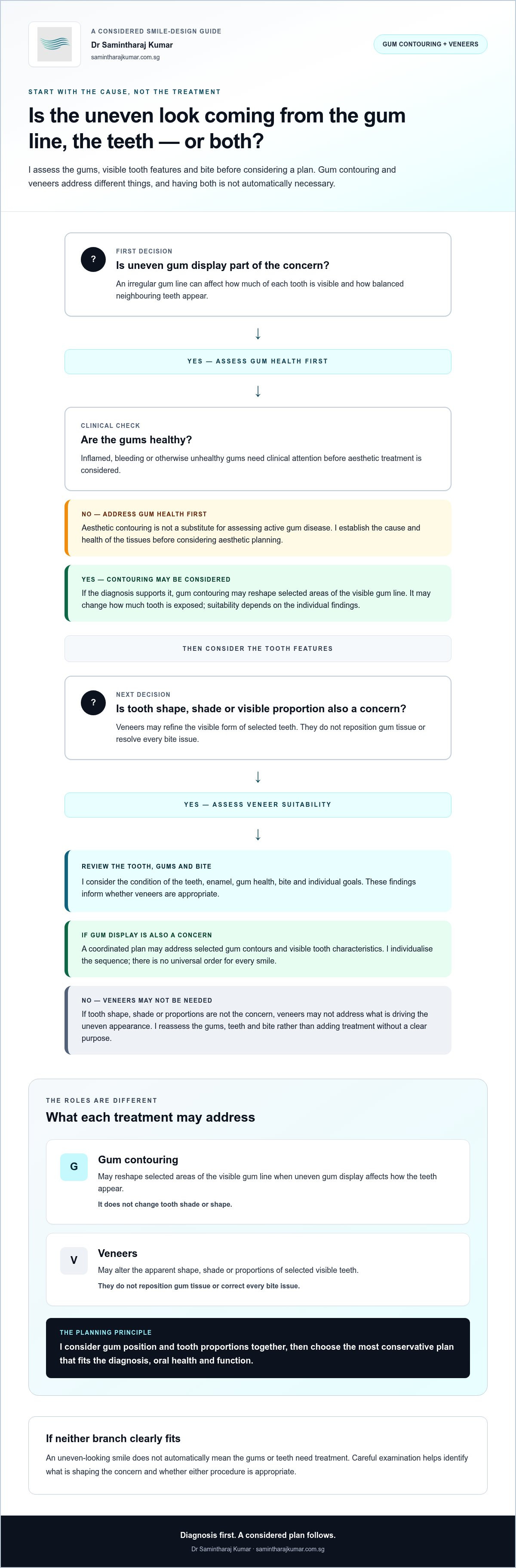
How clinicians plan gum contouring with veneers
A thoughtful plan for combining gum contouring with veneers begins with understanding what you want to change, then checking whether your oral health and dental anatomy support that goal. The sequence matters, but there is no universal order for every patient. I determine it from the clinical findings and intended design, not from a fixed treatment formula.
The planning process moves through five stages:
Discuss your goals. I ask what you notice about your smile and what you hope to improve. A specific concern, such as one tooth appearing shorter, helps focus the assessment without assuming the solution.
Assess oral health. I examine the gums and teeth to identify issues that may need attention before aesthetic treatment is considered.
Evaluate proportions. I look at gum display and visible tooth proportions, as well as how the teeth meet when you bite.
Plan the approach. I consider which treatment, if any, is suitable and whether the findings indicate a particular sequence.
Review the plan. We revisit the clinical picture and your priorities, so the proposed approach remains grounded in assessment rather than assumption.
What an individual smile assessment considers
An individual assessment brings together gum health, tooth condition and the proportions visible in your smile. I also listen to what concerns you most, since a clinical plan should reflect your priorities while staying within the limits of what the tissues and teeth can support. The bite and existing dental work may also be relevant, as they can affect how I assess the teeth and plan restorative care.
This process may indicate that one treatment is appropriate, that both have a role, or that neither is the right response to the concern. That distinction is important. A preference for a particular procedure is part of the conversation, but it does not replace examination or determine the clinical recommendation.
How treatment order and review are determined
The order depends on what the examination shows and how each step relates to the planned outcome. If gum contouring is being considered, I factor in the gum tissues and the way their appearance relates to the teeth before finalising the wider plan. Veneer planning also depends on the condition of the teeth and the bite. I explain the reasoning behind the proposed sequence so you can understand how the stages fit together.
Review points allow me to assess the clinical response and consider whether the next part of the plan remains appropriate. Healing and individual findings influence that review, so I do not promise a fixed timetable or a particular appearance in advance. The plan should respond to what I observe, rather than treat timing as a one-size-fits-all schedule.
For a smile-design discussion, you can explore an individual smile assessment. Careful planning helps clarify the options and keep the focus on a considered outcome for appearance and function.
A considered approach to a more balanced smile
A balanced smile is not created by selecting treatments first. In my clinical experience, the more useful starting point is to understand what feels out of harmony, then assess what the teeth, gums and bite can support. Gum contouring and veneers have distinct roles, but whether either belongs in a plan depends on the individual findings.
My philosophy has always been to place diagnosis before treatment selection. A smile makeover should account for your priorities, oral health and function, rather than pursue appearance in isolation. For some people, the concern may be addressed without combining gum contouring with veneers. For others, a coordinated plan may be worth discussing, provided each step has a clear purpose.
Questions worth discussing during a smile-design consultation
It can help to describe what feels unbalanced in your own words. Is it the gum display, the way certain teeth look, or the overall relationship between them? I use your perspective to guide the conversation, then consider it alongside the clinical assessment.
You may also wish to discuss:
What matters most to you about the appearance of your smile?
How will gum health and existing tooth condition inform the options?
How can healthy tooth structure be respected in treatment planning?
Are there bite or other functional considerations to address?
Which priorities feel realistic and most important to you?
These questions are not a checklist for choosing a procedure. They help establish shared priorities, so the treatment discussion can be clear and grounded in your circumstances. I explain the clinical considerations and how they relate to your goals before we settle on an approach.
How a specialist-led plan brings the elements together
My experience in smile makeovers informs how I consider aesthetic goals alongside oral health and function. It does not make a particular treatment suitable for everyone, nor can it guarantee a specific appearance. Instead, a coordinated assessment helps clarify whether gum contouring, veneers, both or neither are appropriate for the concerns and findings in front of me.
This matters because the elements of a smile are connected. A change intended to improve appearance should be considered in relation to the teeth, gums and bite, not as an isolated cosmetic decision. The plan also needs to be individual: your priorities guide the discussion, while examination shapes what is clinically appropriate.
If you are considering a smile makeover, a considered smile-design discussion can help bring your priorities and the clinical findings together. Bring your questions and the changes you have in mind; the starting point is understanding what matters to you and working through the clinical considerations before deciding on treatment.
Precision in planning supports thoughtful, individualised care. It allows aesthetic decisions to be made with attention to oral health, function and the person behind the smile.
Take the next step towards thoughtful smile design
A smile-design decision is also a chance to clarify what matters to you: a natural-looking appearance, preserving healthy tooth structure, comfortable function, or a considered balance of these priorities. You do not need to arrive with a treatment list. An open conversation about your concerns can help shape a plan around your needs.
In my work as a dental surgeon specialising in smile makeovers and complex dental care, I bring aesthetic planning together with oral health and function. That perspective guides how I assess whether combining gum contouring with veneers may be appropriate for an individual case, without assuming that more treatment is the answer.
To explore your priorities and the clinical considerations behind them, begin a considered approach to smile design. A thoughtful conversation is a positive first step towards care that feels personal, balanced and grounded in understanding.
Frequently Asked Questions
Is gum contouring necessary before getting veneers?
No. If your concern is limited to a tooth’s visible shape or shade, gum contouring may not be relevant to your goals. Before planning veneers, I want to understand what you notice most, including whether a tooth appears short only when you smile or also when your lips are at rest. Sharing that detail can focus the assessment on the change you actually want.
Can veneers correct an uneven gum line?
No. Veneers cannot change the position of the gum margin. They may affect how a tooth’s visible surface is perceived, but that does not establish why the gum line looks uneven. If the appearance varies between a relaxed smile and a broad smile, mention that difference during your consultation. It gives me useful context about when the asymmetry is most noticeable and what you hope to address.
Does gum contouring damage the teeth?
Gum contouring is planned around the gum tissues, but the details depend on your anatomy and the proposed treatment. I would clarify which area is being considered and how nearby tooth surfaces are accounted for in planning. If you have exposed tooth roots, sensitivity or restorations close to the gum margin, mention these. They are useful details when discussing the boundaries and considerations of a proposed procedure.
How long should you wait between gum contouring and veneers?
There is no universal waiting period. Rather than relying on a general calendar estimate, discuss what needs to be reviewed before veneer design is finalised. For example, the gum outline and whether the area is comfortable or showing ongoing irritation may be part of the review. The appropriate interval depends on your clinical response, so your care plan should explain what will inform the next decision.
Can gum contouring and veneers be planned if I have gum inflammation?
Raise active inflammation before cosmetic treatment is planned. To make the discussion more useful, note when you first noticed it, whether it occurs in one area or several, and whether brushing or eating seems to trigger bleeding or tenderness. Mention any recent changes in your oral care routine as well. These details help me understand the concern and determine what should be addressed before discussing aesthetic choices.
Will veneers look natural after gum contouring?
A natural appearance depends on the design as a whole, not just the veneer shade. The shape of the edges, how the teeth relate to one another and how the smile appears in movement can all influence the impression. If you have examples of smiles you find appealing, bring them to the discussion to describe your preferences. They can guide the conversation, though the design must still suit your own features.
Can I choose gum contouring without having veneers?
Yes. A decision about gum contouring does not require you to choose veneers as well. Before considering treatment, be clear about what you hope a change to the gum line would achieve on its own. For example, you might want to address a particular area that draws your attention when smiling. Discussing that specific priority helps set expectations and keeps the conversation centred on the change that matters to you.



Comments