
Dental Implant Singapore: A Specialist’s Perspective on Total Oral Rehabilitation

Updated: Jul 20
What if the limiting factor for your smile restoration isn't actually the volume of your jawbone, but rather the conventional surgical protocols used to assess it? In my clinical experience, many patients seeking a dental implant singapore arrive at Dr Samintharaj Kumar feeling a sense of defeat after being told they aren't candidates for standard treatment. I understand that the fear of surgical failure or the confusion between titanium and ceramic materials can be overwhelming; it's a heavy burden when you're simply seeking the confidence to eat and smile without hesitation.
I promise to guide you through the science of biological compatibility and how we navigate complex cases of bone insufficiency. A 2023 report in the International Journal of Oral & Maxillofacial Implants indicates success rates as high as 98% when specialist protocols are meticulously applied. We'll explore the transition from mere tooth replacement to total oral rehabilitation, ensuring your journey toward a restored quality of life is grounded in clinical expertise and genuine comfort.
Key Takeaways
Understand why I view the dental implant singapore process as a sophisticated bio-mechanical root replacement designed for permanent, total oral rehabilitation.
Compare the biological benefits of titanium and ceramic Zirconia to determine which material best aligns with your aesthetic and health requirements.
Explore how I utilize advanced zygomatic and pterygoid protocols to provide transformative solutions for patients previously told they lacked sufficient bone.
Learn how I leverage AI-assisted diagnostics and 3D CBCT imaging to ensure surgical precision and more predictable outcomes for every patient.
Gain insight into my philosophy on why total oral rehabilitation is a fundamental investment in both your systemic health and long-term quality of life.
Table of Contents
Understanding Dental Implants in Singapore: More Than Just Tooth Replacement
The Biological Evolution of Implant Materials: Ceramic vs. Titanium
Overcoming Complex Challenges: Zygomatic Implants and Full-Arch Rehabilitation
The Precision Journey: AI-Assisted Diagnostics and Surgical Excellence
Beyond the Surgery: My Philosophy on Long-Term Quality of Life
Understanding Dental Implants in Singapore: More Than Just Tooth Replacement
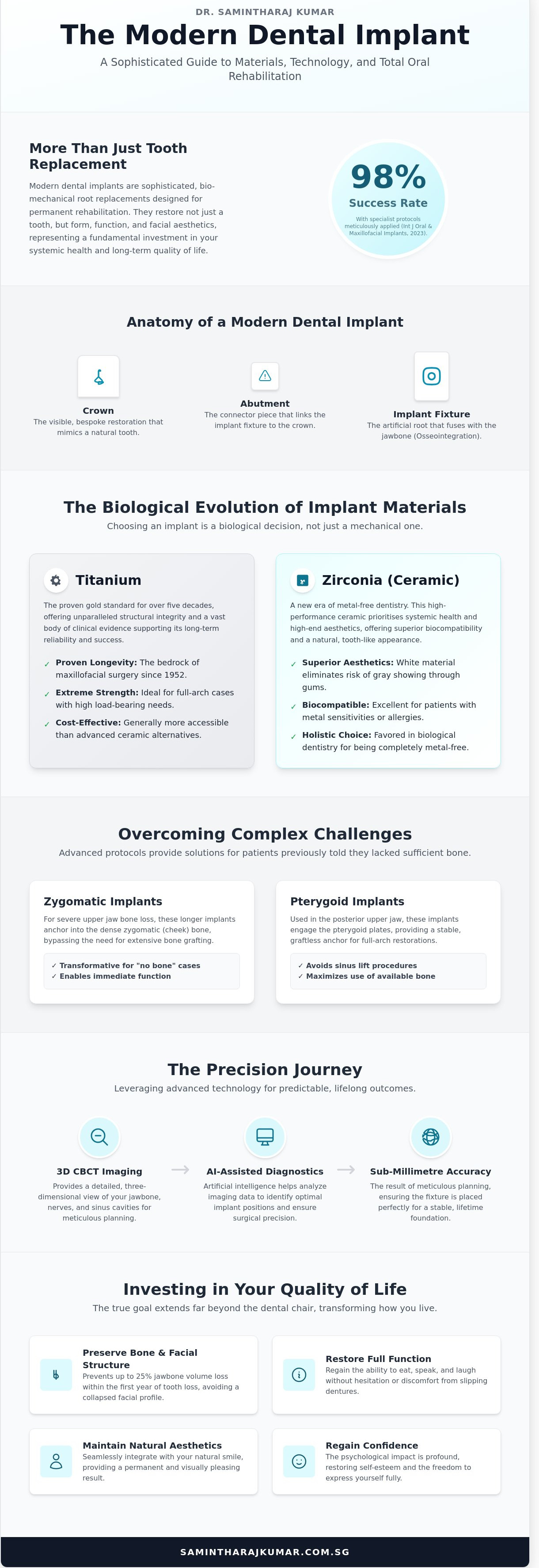
As a clinician and founder, I view the modern dental implant as much more than a simple cosmetic fix. It is a sophisticated, bio-mechanical root replacement designed to mimic the natural physiology of the human mouth. For many years, patients relied on traditional dentures that often slipped or caused discomfort. Today, the shift toward permanent, fixed rehabilitation has transformed how we approach restorative dentistry. Singapore has emerged as a global centre for these advanced protocols, offering world-class standards in surgical precision and patient care. My practice focuses on a "total rehabilitation" philosophy, where we prioritise restoring form, function, and facial aesthetics simultaneously.
For those seeking a comprehensive overview of dental implants, it's helpful to understand that the procedure involves a complex biological integration. When considering a dental implant singapore provides access to some of the most innovative techniques in Southeast Asia, including AI-assisted diagnostics and metal-free ceramic options. The right diagnosis changes everything, and understanding the science behind the treatment is the first step toward a successful outcome.
To better understand this concept, watch this helpful video:
The Anatomy of a Modern Dental Implant
A successful implant relies on a three-part structure. First, the fixture acts as the artificial root, typically made of titanium or zirconia. Second, the abutment serves as the connector. Finally, the bespoke crown is attached to restore the visible tooth. The success of this technology lies in osseointegration, a biological process where the jawbone physically fuses with the implant surface. This stability requires extreme surgical precision during the initial placement phase. In my practice, we use advanced imaging to ensure the fixture is placed with sub-millimetre accuracy, providing a foundation that can last a lifetime.
In My Clinical Experience: Why Early Intervention Matters
I've observed that tooth loss is never just about a gap in a smile. From a biological perspective, the absence of a tooth root leads to rapid jawbone resorption. Clinical data shows that the jawbone can lose up to 25% of its volume within the first year of tooth loss. This degradation often leads to a collapsed facial profile and premature ageing. By choosing a dental implant singapore patients can preserve their natural bone structure and maintain their facial aesthetics.
Beyond the physical consequences, the psychological impact of a compromised smile is profound. Many patients I meet have spent years avoiding certain foods or hiding their laughter. Restoring the ability to eat, speak, and smile without hesitation is the true goal of our treatment. The best outcomes begin with understanding the root cause of the issue and addressing it with a long-term, biological mindset. Helping a patient regain their confidence is a transformative experience that extends far beyond the dental chair. For those seeking to maintain their results through high-quality restorative and cosmetic care, Crystal Bright Smile offers a range of services designed to keep your smile healthy and beautiful.
The Biological Evolution of Implant Materials: Ceramic vs. Titanium
As a clinician and founder, I've observed a profound shift in how we select materials for tooth replacement. Choosing a dental implant in Singapore is no longer a purely mechanical decision. It's a biological one. For over five decades, titanium stood as the undisputed gold standard. However, the emergence of high-performance ceramics like Zirconia has introduced a new era of metal-free dentistry that prioritises both systemic health and high-end aesthetics.
Titanium Implants: Proven Longevity
Titanium has been the bedrock of maxillofacial surgery since 1952. Its reliability is backed by a vast body of clinical evidence. In my clinical experience, medical-grade titanium alloys offer unparalleled structural integrity, particularly for full-arch rehabilitations where load-bearing requirements are extreme. These implants boast success rates often cited between 95% and 98% over a ten-year period. This FDA guide on dental implants confirms that titanium and its alloys are chosen for their ability to resist corrosion and integrate seamlessly with human bone. They remain the pragmatic choice for patients with limited bone volume who require the smallest possible implant diameters.
Ceramic Dental Implants: The Aesthetic and Holistic Choice
Ceramic implants, crafted from Yttria-stabilised Zirconia, are the preferred option for patients seeking a completely metal-free oral environment. From a biological perspective, Zirconia is exceptionally inert. It doesn't conduct heat or electricity; it also eliminates the risk of galvanic corrosion. This is a critical consideration for the approximately 0.6% of the population who may have a diagnosed titanium allergy or those with general metal sensitivities.
The aesthetic benefits are equally compelling. Because Zirconia is naturally white and opaque, it eliminates the "grey shadow" that can sometimes appear at the gum margin with metal implants. This is vital for patients with a thin biotype, where the gingival tissue is naturally delicate. Beyond aesthetics, research indicates that Zirconia surfaces can attract up to 40% less bacterial plaque compared to titanium. This reduced bacterial load promotes healthier soft tissue attachment and may lower the risk of peri-implantitis over time.
My Perspective: The Philosophy of Material Choice In my clinical experience, the material we choose must align with your body's unique chemistry. While titanium is incredibly successful, I believe in offering a choice that respects a patient's desire for holistic wellness. Whether we utilise the proven strength of titanium or the biological harmony of Zirconia, the objective remains life-changing results. I often tell my patients that the right diagnosis changes everything when planning your long-term oral health journey.
Overcoming Complex Challenges: Zygomatic Implants and Full-Arch Rehabilitation
In my clinical experience, the most frequent objection I hear from patients is the belief that they aren't candidates for a dental implant in Singapore because they lack sufficient bone. This "impossible" diagnosis usually follows a traditional assessment that only considers the alveolar bone. When bone has resorbed due to long-term tooth loss or periodontal disease, standard implants may not have enough foundation. However, advanced maxillofacial techniques allow us to look beyond the jawbone to find stability in other cranial structures.
Zygomatic Implants: Hope Beyond Bone Grafting
When a patient presents with severe atrophy in the upper jaw, Zygomatic implants offer a sophisticated alternative to invasive bone grafting. These implants are significantly longer than conventional ones, reaching past the jaw to anchor securely into the zygoma, or cheekbone. Because the cheekbone is dense and does not resorb like the jawbone, it provides an incredibly stable foundation for a new smile.
Zygomatic and Pterygoid implants eliminate the need for multi-stage bone grafts, which can often add 6 to 12 months to the treatment timeline. By using these anatomical anchors, we can often provide a fixed bridge in a single surgical session. This level of care requires a high degree of surgical mastery. Recent research on dental implant materials and computer-assisted surgical guides ensures that we can navigate these complex areas with sub-millimetre precision, prioritising both safety and long-term mechanical success.
All-on-4: The "Teeth in a Day" Transformation
The All-on-4 treatment protocol has revolutionised how we approach total tooth loss. By strategically placing four implants, two of which are tilted at a 45-degree angle in the posterior, we maximise the use of available bone. This configuration allows for the immediate loading of a provisional bridge, giving patients a functional set of teeth in a single day. The aesthetic and psychological benefits of leaving the clinic with a secure smile are profound.
Immediate Function: Patients can eat and speak with confidence almost immediately after surgery.
Bone Preservation: The implants stimulate the jaw, preventing further bone loss.
High Success Rates: Clinical data shows success rates exceeding 95% over a 10-year period for this protocol.
This approach is a cornerstone of our work at Nuffield Dental, where we focus on total rehabilitation rather than just replacing individual teeth. It's about restoring the vertical dimension of the face and the natural harmony of the patient's features. To further support these aesthetic goals through specialized volume restoration and facial contouring, you may learn more about Best Filler Clinic.
My Perspective From a biological perspective, I don't see bone loss as a barrier, but as a challenge that demands a more refined surgical strategy. As a clinician and founder, I have always believed that specialist expertise should turn the "impossible" into the "achievable." My philosophy is rooted in the idea that every patient deserves a fixed, stable solution that enhances their quality of life. Whether we are using Zygomatic protocols or advanced ceramic materials, the goal is always a seamless transition to health. The right diagnosis, backed by global standards like the Malo Clinic protocols, changes everything for a patient who has lost hope in their smile.
The Precision Journey: AI-Assisted Diagnostics and Surgical Excellence
In my clinical experience, the long-term success of a dental implant singapore depends entirely on the data we gather before the procedure begins. We've moved away from the era of "freehand" surgery. Today, I rely on 3D Cone Beam CT (CBCT) scans to create a high-resolution digital map of your unique anatomy. This allows me to see what the naked eye cannot. I evaluate bone density, map out nerve pathways, and identify sinus positions with sub-millimetre precision. By integrating AI-assisted diagnostics, I can predict how a ceramic implant will integrate with your specific bone morphology. This isn't just about placing a tooth; it's about engineering a foundation that respects your biological architecture.
Phase 1: The Comprehensive Assessment
Every successful outcome begins with a detailed digital map. During this assessment, I look for the "why" behind the tooth loss to ensure the new implant doesn't face the same challenges. We use digital scans to evaluate the quality of the alveolar bone. If the bone is too thin, we plan for augmentation. If the sinus is too low, we adjust the protocol. This bespoke treatment plan is aligned with your lifestyle and health goals. It's a proactive approach where we solve potential complications in a virtual environment before they ever manifest in the clinical setting.
Phase 2: The Guided Surgical Procedure
The transition from planning to execution is where digital surgical guides become indispensable. These 3D-printed templates ensure the ceramic implant is placed exactly where we planned it in the digital space, often within a 100-micrometre margin of error. For my patients, this means shorter surgery times and significantly less trauma to the surrounding gums. I often recommend intravenous (IV) sedation for more complex cases to ensure a completely anxiety-free experience. In the immediate 24 to 48 hours post-surgery, most patients report only mild swelling. This is a direct result of the minimally invasive nature of guided surgery, which avoids unnecessary incisions and preserves more of your natural tissue.
My Perspective From a biological perspective, I've always believed that technology should serve the patient's comfort, not just the surgeon's efficiency. As a clinician and founder, I've invested in AI tools because they remove the guesswork from the equation. When we use digital workflows, we aren't just being modern; we're being responsible. We're ensuring that the "Total Rehabilitation" we promise is backed by cold, hard data and warm, empathetic care. In my view, the fusion of AI and human expertise is the only way to achieve truly life-changing results.
The right diagnosis changes everything. If you are considering a metal-free approach to restoration, learn more about our precision-led protocols.
Beyond the Surgery: My Philosophy on Long-Term Quality of Life
In my clinical experience, a dental implant singapore represents far more than a successful surgical procedure; it is a profound investment in one's future health. As a clinician and founder, I view every implant as a gateway to total rehabilitation. We aren't merely replacing missing units. We are restoring the structural integrity of the face and the psychological confidence of the individual. This is the difference between a transactional procedure and a life-changing transformation.
From a biological perspective, the connection between oral health and systemic well-being is undeniable. Chronic oral inflammation is a known risk factor for cardiovascular issues and metabolic disorders. By choosing bio-inert materials like ceramic, we reduce the body's potential inflammatory load. This alignment of dental health with overall physical wellness is a cornerstone of my practice philosophy. We treat the mouth as part of a complex, living system.
Maintaining this investment requires a meticulous approach. While ceramic implants are resistant to decay, the surrounding tissue requires vigilant care to prevent peri-implantitis. I advise my patients to adhere to a strict maintenance protocol. This includes professional prophylaxis every six months and the use of specific, non-abrasive hygiene tools. The Nuffield legacy is built on this commitment to longevity. Since our inception in 2014, we have established 11 clinics across Singapore to ensure that high-tier, specialist-led care is accessible for the decades of follow-up that a dental implant singapore demands.
Total Rehabilitation and the Future of Care
My vision for healthcare in Singapore involves moving beyond the traditional model of "fixing teeth." We focus on restoring lives through a multi-disciplinary approach. For complex cases, this means integrating maxillofacial surgery, prosthodontics, and advanced diagnostics. This holistic strategy ensures that the functional and aesthetic outcomes are seamless. As we look toward the future, the integration of AI-assisted diagnostics and digital workflows will continue to refine these results, making precision the global standard for every patient we serve.
The Best Outcomes Begin with Understanding
I always encourage patients to seek specialist consultations, especially when facing complex rehabilitative needs. Education is the most powerful tool I can provide. When a patient understands the science behind a specific protocol or material choice, they become an active partner in their own recovery. My role is to provide the clinical mastery and the technological framework, but the journey to health is a shared one. The right diagnosis changes everything.
Restoring Confidence Through Clinical Excellence
As a clinician and founder of Nuffield Dental Holdings, I’ve seen how the right approach to a dental implant singapore can fundamentally alter a person’s trajectory. My philosophy centres on total oral rehabilitation, moving beyond the surface to address the biological and structural needs of each patient. By utilising AI-assisted surgical diagnostics and specialist protocols like Zygomatic and All-on-4 implants, we provide solutions for even the most complex cases of bone resorption. These aren’t just technical achievements; they’re pathways to a better quality of life.
In my clinical experience, the marriage of technology and empathy creates the most predictable results. We don’t just replace teeth; we rebuild the foundation of your health using globally recognised standards and precise surgical mastery. This commitment to innovation ensures your journey is safe, sophisticated, and life-changing. The best outcomes begin with understanding the root cause. Explore our specialist approach to dental implants. I look forward to helping you reclaim the comfort and function you deserve.
Frequently Asked Questions
Can I use Medisave to pay for my dental implant in Singapore?
You can use your Medisave for the surgical placement of a dental implant in Singapore. Under current Ministry of Health (MOH) guidelines, Singaporeans and Permanent Residents may claim up to $950 for the surgical insertion of each individual implant. In my clinical experience, this helps alleviate the initial financial commitment of total oral rehabilitation while ensuring patients receive high-tier, specialist-led care that prioritises long-term health and well-being.
How long does the entire dental implant process take from start to finish?
The entire dental implant process typically spans 3 to 9 months from the initial consultation to the final restoration. This timeline accounts for the biological requirement of osseointegration, where the jawbone fuses with the implant over 12 to 24 weeks. If I perform immediate loading protocols, the functional transformation occurs faster; however, a meticulous, staged approach ensures the long-term stability and quality of life for my patients.
Are ceramic dental implants better than titanium ones?
From a biological perspective, ceramic implants offer superior gingival health and zero metal corrosion. While titanium has been the industry standard since 1965, zirconia is chemically inert and prevents the greyish shadow often seen at the gumline. As a clinician and founder, I recommend ceramic for patients with metal sensitivities or those seeking the most natural aesthetic outcome for a dental implant in Singapore to ensure seamless integration.
Is the dental implant procedure painful under specialist care?
The dental implant procedure isn't painful because we utilise advanced local anaesthesia and intravenous sedation to ensure your complete comfort. Most patients report a 2 out of 10 on the pain scale during recovery, which is easily managed with standard analgesics. My focus is on creating a seamless, anxiety-free environment where clinical precision meets a patient-centred philosophy to lower the barrier of fear often associated with surgery.
What is the success rate of dental implants for smokers?
Smoking reduces the success rate of dental implants by approximately 11% compared to non-smokers. Nicotine constricts blood vessels, which impairs the vital healing process and increases the risk of peri-implantitis or infection. I advise patients to cease smoking for at least 14 days before and 42 days after surgery to support healthy tissue integration. This commitment is essential for ensuring the longevity of your clinical outcome and overall health.
What happens if I don’t have enough bone for a standard implant?
If you lack sufficient bone density, I often perform a bone graft or a sinus lift to create a stable foundation for the implant. For more complex cases involving severe atrophy, I may utilise zygomatic protocols that anchor into the cheekbone instead. These advanced surgical techniques ensure that almost every patient can achieve a life-changing result regardless of their initial bone volume or the history of their previous tooth loss.
How do I care for my dental implants to ensure they last a lifetime?
You should treat your implants like natural teeth by brushing twice daily and using interproximal brushes to keep the margins clean. Regular professional maintenance every 6 months is vital to monitor the health of the surrounding bone and soft tissue. In my clinical experience, meticulous home care combined with specialist reviews allows these restorations to function effectively for 25 years or more, providing a lasting legacy for your smile.
What is the difference between a general dentist and a specialist for implants?
A specialist, such as an oral surgeon or prosthodontist, has completed 3 years of additional residency training beyond basic dental school. While a general dentist can perform simple cases, a specialist possesses the expertise to manage complex surgical risks and intricate aesthetic nuances. As a clinician and founder, I believe this level of specialised mastery is essential for achieving the predictable, life-changing results that our patients expect from modern medicine.
After graduating with a BDS from Singapore in 2001 and an MBBS from London in 2006, my training journey expanded across oral and maxillofacial surgery, implantology, plastic surgery, craniofacial medicine, facial aesthetics, and advanced rehabilitation workflows. Over the years, I have developed a particular focus in dental implantology, All-on-4 full arch rehabilitation, zygomatic and pterygoid implants, ceramic dental implants, biological dentistry, TMJ pain management, smile design, regenerative protocols, PRF, ozone therapy, and AI-assisted diagnostics.
As both a clinician and founder, my philosophy has always centred on understanding the root cause before designing precision-led solutions. This applies equally to complex patient care, healthcare systems, digital transformation, and the future of scalable care delivery.
Beyond clinical practice, I actively write and speak on healthcare entrepreneurship, artificial intelligence in diagnostics, dental support organisations, private equity in healthcare, leadership development, and the future of patient-centred care in Southeast Asia and the Middle East. My work reflects a broader mission: to build institutions, nurture future leaders, and shape a more intelligent, accessible, and biologically driven model of healthcare.
Through my writing, I share clinical insights, founder lessons, patient philosophies, and forward-looking perspectives on healthcare innovation, always with the belief that the best outcomes begin with better thinking, earlier diagnosis, and systems built around trust.

Comments