
How Dental Structure Affects Face Shape: A Surgeon’s Perspective on Structural Rejuvenation

Have you ever wondered why your face seems to be losing its definition, even when your skincare routine remains flawless? It's a deeply personal frustration to notice a premature aging appearance or a subtle shift in facial symmetry that topical treatments simply cannot reach. From a biological perspective, your teeth and jaw act as the essential scaffolding for your entire face. When this foundation is compromised, the resulting loss of volume can be profound, making the strategy of preventing facial collapse with dental implants a cornerstone of modern aesthetic restoration.
In my clinical experience as a surgeon and founder, I've seen how restorative dentistry goes far beyond a beautiful smile; it's about structural rejuvenation. My promise is to show you how the underlying architecture of your jaw defines your aesthetics and how we can reclaim that youthful harmony. We'll explore the critical link between bone health and facial volume, identifying the surgical and non-surgical options available to you. By understanding these clinical foundations, you'll discover how to achieve a more balanced, youthful, and confident facial profile through precise, patient-centered care.
Key Takeaways
Understand how your jawbone acts as the essential scaffolding for your face, dictating the projection of your features and overall facial harmony.
Learn why the biological process of bone resorption occurs after tooth loss and how it directly leads to the appearance of a shortened or sunken face.
Explore the clinical importance of preventing facial collapse with dental implants to restore your bite's vertical dimension and soften deep nasolabial folds.
Discover why structural restoration with ceramic or zygomatic implants provides a more sustainable, holistic outcome than temporary aesthetic fillers.
Gain a surgeon's perspective on how advanced restorative techniques reclaim not just your smile, but your functional health and youthful facial profile.
Table of Contents
The Architecture of the Smile: How Dental Structure Supports Facial Harmony
The Biological Chain Reaction: Why Bone Loss Leads to Facial Collapse
Beyond the Surface: The Clinical Consequences of a Collapsed Bite
My Perspective: Restoring Facial Volume through Advanced Implantology
The Long-term Impact: Achieving Sustainable Facial Rejuvenation
The Architecture of the Smile: How Dental Structure Supports Facial Harmony
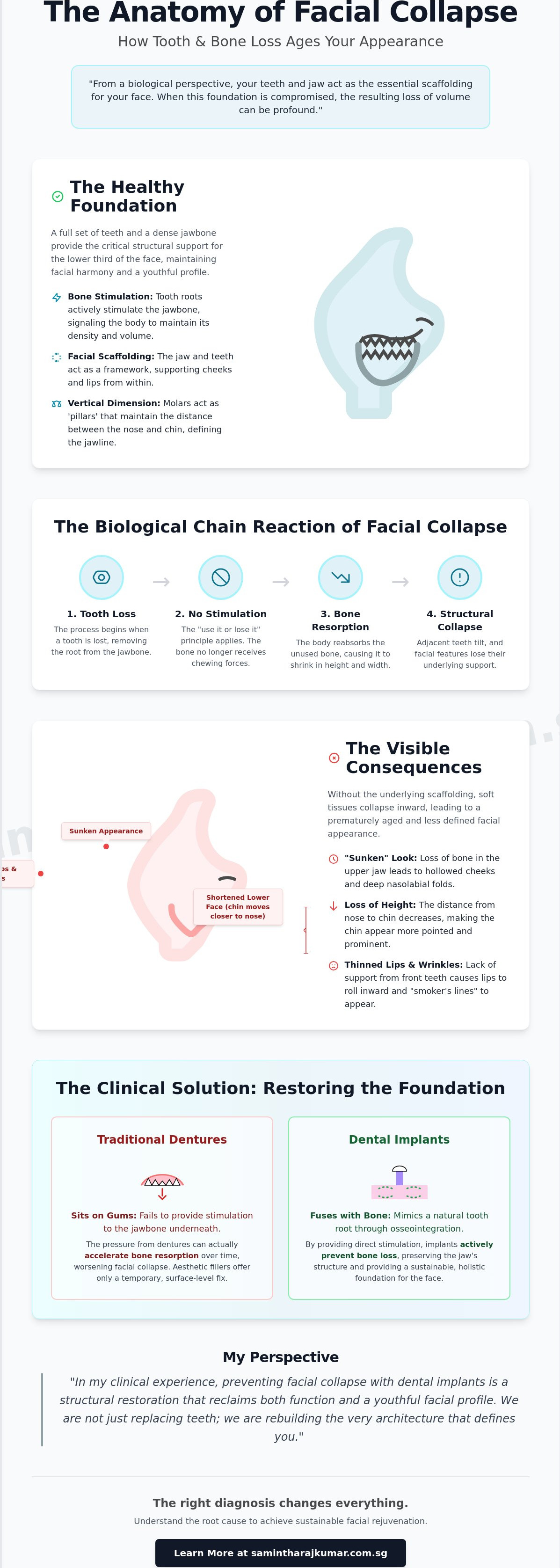
From a biological perspective, I view the human face not as a collection of separate features, but as a unified dental-facial complex. This interdependent anatomical system relies on the hard structures of the mouth to define the contours we see in the mirror. The maxilla, or upper jaw, and the mandible, your lower jaw, provide the essential projection that determines the shape of your profile. Without this underlying support, the skin and muscles of the lower third of the face lose their tension, leading to a prematurely aged appearance.
To better understand how these structures interact to maintain your appearance, watch this helpful video:
The hard tissues of your mouth provide the necessary resistance for soft tissues like your cheeks and lips. When teeth are lost or the jawbone diminishes, this resistance vanishes. It's why preventing facial collapse with dental implants is such a critical component of my restorative philosophy. By replacing the root structure, we maintain the bone volume required to keep the face from falling inward. This stability is achieved through the process of osseointegration, where the implant becomes a permanent part of your anatomy.
The Scaffolding Effect of Healthy Teeth
The position of your teeth directly determines the fullness of your lips. When the front teeth lack proper projection, the lips begin to thin and collapse, often creating the fine vertical lines colloquially known as smoker lines. In my clinical experience, patients often overlook how posterior teeth support the vertical height of their face. Your molars act as pillars. If their height is reduced through wear or loss, the jawline loses its definition and the chin moves closer to the nose, creating a sunken look.
Facial Symmetry and Occlusal Balance
An uneven bite does more than just make chewing difficult. It often leads to the overdevelopment of jaw muscles on one side as the body attempts to compensate, which eventually manifests as visible facial asymmetry. I place immense value on how dentists measure bite alignment to ensure that every restoration promotes long term balance. Occlusal precision dictates the resting position of your facial muscles, ensuring they remain relaxed and symmetrical rather than strained. Preventing facial collapse with dental implants begins with this meticulous attention to structural harmony.
The Biological Chain Reaction: Why Bone Loss Leads to Facial Collapse
From a biological perspective, the jawbone is a highly specialized tissue that exists primarily to support your teeth. It operates on a strict "use it or lose it" principle. When a tooth is lost, the alveolar bone that once surrounded the root no longer receives the mechanical stimulation generated by chewing. This lack of activity signals the body to reabsorb the minerals from the jaw, leading to a steady decline in bone density and volume. This isn't merely a local concern; it triggers a domino effect where adjacent teeth begin to tilt and shift, further destabilising the structural integrity of your entire face.
Traditional dentures often exacerbate this issue. Because they sit on top of the gum line rather than being anchored within the bone, they fail to provide the necessary stimulation to the jaw. In fact, the pressure from dentures can actually accelerate bone resorption over time. This is why I advocate for preventing facial collapse with dental implants as a proactive measure. Unlike other restorations, implants prevent bone damage by mimicking the natural tooth root, ensuring the jawbone remains robust and functional.
Alveolar Bone Resorption and The Sunken Look
As the alveolar bone thins and recedes, the physical changes become visible. The mid-face area, which relies on the maxilla for support, begins to hollow out, leading to a sunken appearance in the cheeks. This loss of height in the jawbone causes the lower face to "telescope." The distance between the nose and the chin decreases, which often makes the chin appear to point upwards and move closer to the nose, a hallmark of advanced facial collapse.
The Impact on Soft Tissue Elasticity
When the underlying bone volume disappears, the soft tissues of the face are left without their foundation. This excess skin has nowhere to go but down, resulting in the formation of jowls and sagging skin around the neck. While superficial treatments like fillers can temporarily mask these changes, they don't address the biological root cause. In my clinical experience, managing the entire neuromuscular environment is key. For patients whose bone loss is accelerated by excessive force, I often recommend exploring the benefits of botox for teeth grinding to protect the structural integrity of the mouth. Achieving a lasting result requires a deep understanding of how your biological health impacts your aesthetic profile.
Beyond the Surface: The Clinical Consequences of a Collapsed Bite
When I evaluate a patient, I look far beyond the alignment of their teeth; I assess the Vertical Dimension of Occlusion (VDO). This clinical term refers to the distance between the maxilla and mandible when the teeth are in contact. It's the measurement that defines the length of the lower third of your face. When this dimension is lost due to missing teeth or significant wear, the face effectively shortens. This collapse isn't just a dental issue; it's a structural failure that fundamentally alters your facial aesthetics.
The aesthetic consequences of a reduced VDO are often mistaken for simple skin ageing. As the jaw over-closes, the soft tissues of the face begin to sag because they no longer have a sufficient frame to drape over. This leads to the deepening of nasolabial folds and the appearance of marionette lines at the corners of the mouth. Additionally, a collapsed bite often forces the mandible to rotate forward and upward. This creates a prognathic profile where the chin appears too prominent, while the mid-face looks sunken and hollow. Preventing facial collapse with dental implants allows us to re-establish this lost vertical height, providing a permanent solution to these structural shifts.
From a biological perspective, these changes often lead to functional distress. When the bite is no longer balanced, the temporomandibular joint (TMJ) is forced to operate in an unnatural position. This frequently results in chronic discomfort, clicking sounds, and tension headaches. The link between your dental architecture and your physical comfort is absolute; you cannot truly address one without the other.
Identifying a Collapsed Bite
In my clinical experience, patients often notice the symptoms of a collapsed bite before they understand the cause. You might observe several key indicators during a self-assessment:
Lips that appear thinner or seem to disappear when the mouth is closed.
The corners of the mouth turning downward into a permanent frown.
Excessive tooth wear, known as attrition, which flattens the biting surfaces.
A chin that appears disproportionately close to the nose when resting.
Restoring a bite is as much about facial rejuvenation as it is about dental function. It's the process of rebuilding the foundation so the rest of the face can sit in its correct anatomical position.
The Psychological Impact of Structural Changes
The loss of facial volume can have a profound impact on self-esteem. Many patients feel their reflection no longer matches their internal sense of vitality. While traditional cosmetic fillers can temporarily mask these hollows, they do nothing to stop the underlying bone loss. I believe in a more holistic approach. By focusing on restoring facial volume with dental reconstruction, we achieve a more natural and enduring "lift." Preventing facial collapse with dental implants provides the structural integrity needed to reclaim your confidence, ensuring your facial profile remains balanced and youthful for decades to come.
My Perspective: Restoring Facial Volume through Advanced Implantology
As a clinician and founder, my philosophy centres on the concept of Total Rehabilitation. This means I don't just look at an isolated missing tooth; I look at how that loss affects your entire facial profile. In my clinical experience, the most successful outcomes occur when we treat the mouth as the foundation of facial aesthetics. By preventing facial collapse with dental implants, we aren't just restoring a bite; we're performing a structural rejuvenation that supports the lips and cheeks from within. This approach ensures that the "lift" we achieve is rooted in biological reality rather than superficial camouflage.
The All on 4 protocol, often referred to as Teeth in A Day, is a cornerstone of this structural strategy. It provides immediate support for the soft tissues, effectively "lifting" the lower face in a single session. This is particularly transformative for patients who have suffered from a shortened facial height due to long-term tooth loss. By strategically placing four or more implants, we can re-establish the vertical dimension of the face, giving the cheeks and lips the scaffolding they need to remain full and youthful.
Biocompatibility and Bone Health
From a biological perspective, the materials we place in your body matter immensely. I often prioritise Ceramic Dental Implants made from zirconia for health-conscious patients. These are highly biocompatible and offer premium aesthetic excellence, mimicking the natural translucency of teeth while remaining completely metal-free. These implants act as artificial roots, signaling the body to maintain bone density and halting the resorption process permanently. To ensure the most precise results, I integrate AI-assisted diagnostics into my planning process at Nuffield Dental. This technology allows me to map out your perfect facial profile with mathematical precision before the surgery even begins.
The Role of Zygomatic and Pterygoid Implants
For patients who have been told they aren't candidates for traditional implants due to severe bone loss in the upper jaw, advanced protocols like Zygomatic Dental Implants are game-changers. These specialised implants anchor into the denser facial bones, such as the cheekbone, rather than relying solely on the maxilla. This provides a rock-solid foundation for a new smile and restores mid-face volume that has been lost over years of collapse. These protocols can bypass the need for extensive and time-consuming bone grafting, allowing for a faster transition to a restored life. Preventing facial collapse with dental implants is possible even in the most complex cases when we look beyond traditional boundaries.
The right diagnosis changes everything when it comes to your long-term facial harmony. If you are ready to explore how structural rejuvenation can impact your profile, you can learn more about my approach to comprehensive dental implants and facial restoration.
The Long-term Impact: Achieving Sustainable Facial Rejuvenation
In my clinical experience, patients often seek out dermal fillers to address sagging skin or deep folds without realising the root cause is structural rather than superficial. While fillers provide a temporary volume boost, they cannot halt the underlying bone resorption that occurs when teeth are missing. From a biological perspective, true longevity in facial aesthetics requires a permanent foundation. This is where the strategy of preventing facial collapse with dental implants becomes an essential anti-ageing intervention. By anchoring the jawbone, we provide a lifetime of support that topical or injectable treatments simply cannot match. It's the difference between masking a symptom and treating the biological cause.
Beyond the mirror, the impact of a restored bite is profound and multi-faceted. It isn't just about aesthetics; it's about the restoration of your quality of life. I've seen how a stable foundation leads to better nutrition because patients can once again enjoy a varied, healthy diet without hesitation. It also results in clearer speech, as the tongue and lips have the necessary dental scaffolding to articulate sounds correctly. Most importantly, it leads to lasting confidence. The emotional renewal that comes when your external appearance finally aligns with your internal vitality is the most rewarding part of my work as a clinician and founder.
The Synergy of Dental and Facial Aesthetics
I often combine oral surgery with targeted Facial Aesthetic Rejuvenation to achieve a comprehensive, natural result. A personalised treatment plan must respect your unique facial proportions. We aren't just creating a generic smile; we're restoring your specific anatomy. I encourage my patients to view dental health not as a separate concern, but as the very cornerstone of their overall appearance. When we stabilise the jawbone, we create a canvas that allows other aesthetic treatments to perform more effectively and last longer.
Conclusion: The Best Outcomes Begin with Understanding
The link between dental structure and the perceived age of your face is absolute. As we've explored, the architecture of your teeth and jaw defines the harmony of your features. Reclaiming that harmony requires more than just general dentistry. It demands specialist expertise in complex rehabilitative cases and a deep understanding of how bone health impacts facial volume. Preventing facial collapse with dental implants is a journey from clinical diagnosis to emotional renewal, ensuring your profile remains balanced and youthful. My goal is to ensure you feel informed and secure as we rebuild your foundation. The right diagnosis changes everything.
Reclaiming Your Natural Profile through Structural Harmony
Your face is a reflection of the foundation beneath it. As a clinician and founder at Nuffield Dental, I've dedicated my career to understanding the delicate interplay between dental health and facial aesthetics. We've explored how the loss of tooth roots triggers a biological decline in bone volume, but more importantly, we've seen that this process is reversible. By prioritising the health of your jawbone, you aren't just fixing your teeth; you're investing in a long-term anti-ageing strategy that preserves the natural contours of your face.
In my clinical experience, the most profound transformations happen when we look at the face holistically. Whether through the precision of ceramic implants or the advanced capabilities of zygomatic protocols for complex bone loss, our goal is total rehabilitation. The focus is always on preventing facial collapse with dental implants to ensure your profile remains balanced and vibrant. True rejuvenation begins when we address the underlying architecture, combining surgical excellence with an empathetic, patient-centred philosophy.
I look forward to helping you reclaim the youthful harmony and lasting confidence you deserve.
Frequently Asked Questions
Can missing teeth really make my face look older?
Yes, missing teeth cause the jawbone to reabsorb, which leads to a shortened facial height and sagging skin. From a biological perspective, your teeth support the lower third of your face. Without that support, the lips begin to thin and the chin moves closer to the nose, creating a sunken, prematurely aged appearance that skincare alone cannot fix.
How does a misaligned bite affect my jawline and profile?
A misaligned bite often results in uneven muscle development and a jawline that loses its sharp, youthful definition. In my clinical experience, when the upper and lower teeth don't meet correctly, the mandible may sit too far back or forward. This alters your profile and can make the cheeks appear hollow or the chin look disproportionately weak.
Will dental implants fix my sunken cheeks?
Dental implants can significantly improve the appearance of sunken cheeks by halting bone loss and supporting the overlying soft tissue. By replacing the natural root structure, they maintain the volume of the maxilla. This provides the necessary scaffolding for your cheeks to sit in their natural position, restoring a more balanced and vibrant facial contour.
What is the Vertical Dimension and why does it matter for my face shape?
The Vertical Dimension of Occlusion is the measurement of the lower face height when your teeth are in contact. It's critical because it dictates how the skin and muscles of your face are draped. If this dimension is lost due to tooth wear or loss, the face collapses vertically, which creates deep folds and a "telescoped" look.
Can orthodontics alone correct major facial asymmetry?
Orthodontics can align your teeth, but they often cannot correct asymmetry caused by underlying bone loss or skeletal deficiencies. In cases where the jawbone has significantly receded, preventing facial collapse with dental implants is often required. This addresses the structural root cause of the asymmetry by rebuilding the foundation of the face rather than just moving teeth.
How long does it take to see facial changes after dental reconstruction?
You will often see an immediate improvement in lip fullness and facial height if we use immediate-load protocols like All on 4. While the final refinement occurs as the soft tissues settle over several months, the initial structural lift is visible the same day. Long term, the implants ensure these changes remain sustainable by preventing further bone resorption.
Is it possible to restore facial volume if I have severe bone loss?
It's absolutely possible to restore volume even with severe bone loss by using advanced techniques like Zygomatic Dental Implants. These specialised implants anchor into the cheekbones, providing a stable foundation where traditional implants cannot. As a clinician and founder, I've seen these protocols successfully reclaim facial profiles for patients who were previously told they had no restorative options.
What is the difference between a traditional face lift and dental rejuvenation?
A traditional face lift tightens the skin, whereas dental rejuvenation rebuilds the underlying structure that actually supports that skin. Preventing facial collapse with dental implants addresses the biological cause of a sagging face. By restoring the jawbone and teeth, we provide a natural foundation that ensures any aesthetic improvements are rooted in your actual anatomy.


Comments