
What Kind of Doctor Treats TMJ? A Surgeon’s Perspective on Jaw Rehabilitation

What if the persistent migraines and facial tension you're enduring aren't a neurological problem, but a precise mechanical misalignment of your jaw? In my clinical experience, patients often spend years in a state of painful limbo because they simply aren't sure what kind of doctor treats tmj or when their symptoms require a specialist's intervention. It's a common struggle to navigate the gap between a general practitioner and a maxillofacial surgeon, especially when you're fearful that surgery might be the only definitive answer.
I understand the exhaustion that comes with chronic jaw pain. In this article, I'll guide you through the clinical hierarchy of care so you can identify the right expert for your stage of discomfort. We'll examine the role of advanced diagnostics and the transition from conservative management to sophisticated surgical rehabilitation. By the end, you'll have a clear roadmap for your recovery and a better understanding of how modern medicine restores both function and quality of life. The right diagnosis changes everything, and finding the correct specialist is the first step toward lasting relief.
Key Takeaways
Understand the clinical hierarchy of care, moving from early-stage dental intervention to the high-tier expertise of an Oral and Maxillofacial Surgeon.
Identify exactly what kind of doctor treats tmj at every stage of your symptoms, ensuring you find the right specialist for your specific needs.
Learn why advanced diagnostics like AI-assisted 3D imaging are essential for separating complex jaw disorders from similar conditions like ear pain or migraines.
Discover a biological, multidisciplinary philosophy that prioritises long-term functional excellence through a combination of surgery and specialist physiotherapy.
Gain a clear roadmap of the rehabilitation journey to help you set realistic expectations for healing and profound personal restoration.
Table of Contents
Navigating the Complexity of TMJ Disorders
The temporomandibular joint is one of the most sophisticated anatomical structures in the human body. It functions as a complex sliding hinge, connecting your jawbone to the skull and facilitating the intricate three-dimensional movements required for speaking, chewing, and yawning. Because this joint is in constant use, even a minor misalignment can trigger a cascade of physiological issues. In my clinical experience, I've seen many patients arrive at our clinic after months of confusion regarding what kind of doctor treats tmj, often having already visited their GP for suspected ear infections or chronic migraines.
This confusion is understandable. Jaw pain rarely stays confined to the jaw. It often mimics other conditions, leading to referred pain in the temples, the neck, and even the inner ear. This spectrum of conditions is medically classified as Temporomandibular joint dysfunction (TMD). As a clinician and founder, I believe it's vital to view TMD not as a single ailment, but as a progressive spectrum of neuromuscular and skeletal challenges that require precise, early intervention to prevent long-term joint degradation.
To better understand the mechanics of your jaw and how these issues develop, watch this helpful assessment video:
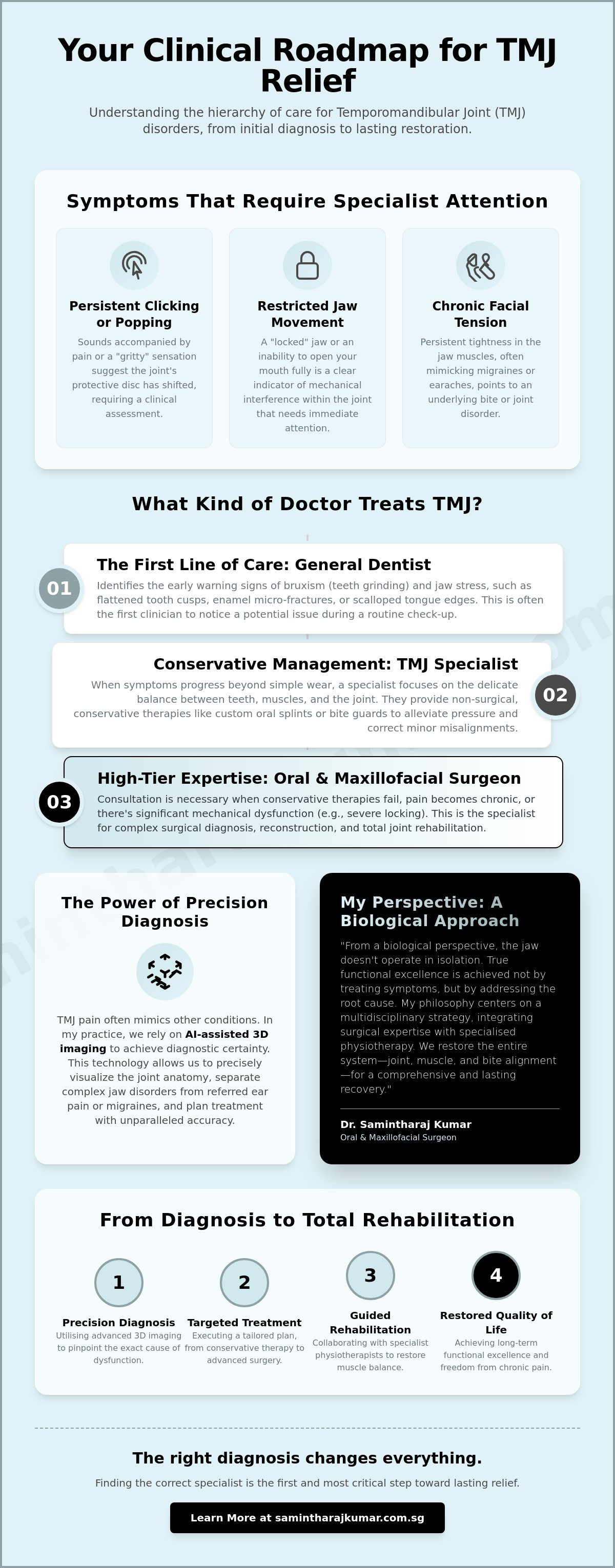
Common Symptoms That Require Specialist Attention
Persistent clicking or popping: While occasional noise is common, sounds accompanied by pain or a "gritty" sensation often indicate that the protective disc within the joint has shifted.
Restricted jaw movement: If your jaw feels "locked" or you cannot open your mouth fully to eat, it's a clear sign of mechanical interference within the joint.
Chronic facial tension: Unexplained tightness in the masseter muscles that doesn't respond to standard over-the-counter pain relief usually suggests an underlying bite or joint issue.
Why a Multidisciplinary Approach is Essential
From a biological perspective, the jaw doesn't operate in isolation. Its health is deeply influenced by dental occlusion (how your teeth meet), muscular health, and even systemic biological factors like inflammation. Determining what kind of doctor treats tmj depends entirely on where you fall on the clinical spectrum of joint degradation. A general dentist might spot the early signs of wear from bruxism, but a complex case requires a specialist who can coordinate a holistic recovery plan.
In our practice, we prioritise treating the root cause rather than merely masking the symptoms with temporary fixes. This often involves a multidisciplinary strategy, where we align surgical expertise with specialised physiotherapy and advanced diagnostics. By addressing the cervical spine alignment and muscular balance alongside the joint itself, we achieve a level of functional excellence that a single-discipline approach simply cannot match. The goal is always comprehensive restoration, ensuring your jaw functions with the quiet, effortless precision it was designed for.
The First Line of Care: Dentists and TMJ Specialists
For most patients, the journey toward relief begins in the general dentist's chair. A dentist is often the first clinician to identify the physical signatures of bruxism, such as flattened tooth cusps, micro-fractures in the enamel, or scalloped edges on the tongue. These are the early warning signs of a system under stress. However, when simple tooth wear escalates into debilitating facial tension, the question of what kind of doctor treats tmj becomes more critical. While a generalist can manage early symptoms, a dedicated TMJ specialist focuses on the delicate balance between the teeth, the muscles, and the joint itself.
As a clinician and founder, I've observed that a "wait and see" approach often allows minor joint clicks to evolve into permanent disc displacement. We shouldn't just look at the teeth; we must evaluate the joint architecture. Conservative therapy is an excellent starting point, but its limitations must be recognised. If a patient doesn't respond to basic interventions within a few weeks, it's a clear signal that the underlying pathology requires a higher tier of expertise. In my clinical experience, early intervention is the most effective way to avoid the need for more invasive procedures later in life.
Orthodontic Considerations in Jaw Alignment
Malocclusion, or a "bad bite," is a primary driver of joint stress. When teeth don't meet harmoniously, the jaw muscles must work overtime to find a stable resting position. This constant strain places uneven pressure on the temporomandibular joints, leading to inflammation and pain. Orthodontic intervention is about more than just a straight smile; it's about creating a functional foundation. Correcting the bite is often a non-negotiable prerequisite for long-term relief, as it removes the mechanical triggers that cause the joint to flare up.
The Role of Splint Therapy and Bite Guards
There's a significant clinical difference between a generic pharmacy night guard and a precision-engineered clinical splint. According to the National Institute of Dental and Craniofacial Research, treatments should be reversible and conservative whenever possible. A custom stabilising splint does more than protect teeth from grinding; it facilitates neuromuscular reprogramming. By slightly altering the jaw's position, we decompress the joint and allow the surrounding musculature to relax.
Monitoring the progress of this therapy is vital. If a standard splint is poorly adjusted, it can actually worsen certain types of joint displacement. If you're currently managing persistent discomfort that isn't responding to basic guards, exploring specialised TMJ pain management can help determine if your condition requires advanced intervention. The right diagnosis changes everything, and understanding the nuances of your joint's movement is the only way to ensure a successful outcome.
When to Consult an Oral and Maxillofacial Surgeon
The Oral and Maxillofacial Surgeon represents the most advanced tier of expertise in the clinical hierarchy of jaw health. While generalists focus on the teeth and musculature, a surgeon is specifically trained to manage the delicate interplay between bone, cartilage, and the synovial fluid within the joint capsule. In my clinical experience, patients often reach out to ask what kind of doctor treats tmj when conservative methods, such as splints or physiotherapy, have failed to provide lasting relief. At this stage, the focus shifts from managing surface symptoms to correcting underlying structural pathologies.
From a biological perspective, surgery is not merely a "last resort" but a sophisticated tool for functional restoration. I believe that modern maxillofacial care should prioritise precision and minimally invasive techniques. We are no longer limited to large, open-joint procedures; instead, we utilise technology to intervene with surgical accuracy while preserving the integrity of the surrounding tissues. This ensures a faster recovery and a more predictable outcome for those facing complex joint challenges.
Advanced Diagnostics: AI and 3D Imaging
Subjective pain reports are a helpful starting point, but they don't provide the objective data needed for a definitive surgical plan. We now employ AI-assisted 3D diagnostics to analyse joint stress patterns with incredible accuracy. This technology allows us to visualise how forces are distributed across the joint during movement, identifying "hot spots" that traditional imaging might miss. As Johns Hopkins Medicine on TMD highlights, the complexity of this joint's anatomy is vast. This is why MRI is a non-negotiable diagnostic standard in our practice. While X-rays show bone, only an MRI can accurately depict the position and health of the soft tissue disc. Without this clarity, any treatment is merely guesswork.
Minimally Invasive Surgical Interventions
When structural damage is identified, we move toward targeted interventions designed to restore mobility and reduce inflammation. These procedures are often performed in a day-surgery setting, allowing patients to return home shortly after the intervention.
Arthrocentesis: This procedure involves flushing the joint space with a sterile solution to remove microscopic inflammatory byproducts. It's a highly effective way to reset the joint environment and break up minor adhesions that restrict movement.
TMJ Arthroscopy: Using micro-cameras, we can visualise the internal joint space in real-time. This allows us to diagnose issues and perform therapeutic adjustments, such as repositioning a displaced disc, through tiny, nearly invisible incisions.
For patients facing significant structural loss or advanced degenerative arthritis, we look toward total jaw rehabilitation. This is where clinical mastery meets innovation, ensuring that every patient has a pathway back to a life free from the constraints of chronic jaw pain. The best outcomes begin with understanding the root cause, and advanced imaging is the key to unlocking that clarity.
The Biological Approach: Multidisciplinary Care and My Perspective
From a biological perspective, we must look beyond the mechanical hinge of the jaw to understand the environment in which it functions. Chronic joint issues are rarely isolated events. They are often influenced by systemic inflammation, which can exacerbate the degradation of cartilage and soft tissues. When patients ask what kind of doctor treats tmj, they often expect a single name. However, true rehabilitation requires an integrated team that addresses the biological, neurological, and structural components of the disorder simultaneously.
In my clinical experience, the most successful outcomes occur when we bridge the gap between surgical precision and allied health expertise. This might involve collaborating with neurologists to address chronic nerve-related pain or pain management specialists to desensitise overactive neural pathways. By treating the patient as a whole biological system, we move away from temporary fixes and toward a state of functional excellence. This holistic philosophy is the cornerstone of how we approach complex cases at Nuffield Dental.
Physiotherapy and Neuromuscular Rehabilitation
Specialist physiotherapy is an essential component of the recovery journey. It's not simply about general exercises; it's about targeted neuromuscular rehabilitation designed to restore the range of motion and reduce muscle guarding. There is a profound link between your posture, the cervical spine, and temporomandibular function. If the neck is misaligned, the jaw muscles must compensate, leading to a cycle of tension and pain. Integrating physical therapy with our clinical interventions creates a synergistic effect that speeds up the healing process and ensures long-term stability.
Aesthetic Integration: Botox and Facial Rejuvenation
We also utilise therapeutic Botox as a sophisticated tool to "down-regulate" overactive masseter muscles. While many associate this with facial aesthetics, its clinical value in TMJ care is significant. By temporarily reducing the force of involuntary clenching, we allow the joint to rest and recover. Interestingly, managing jaw tension in this way often results in a secondary benefit: improved facial symmetry and a more relaxed, youthful appearance. This is a prime example of how facial aesthetic rejuvenation and functional health are deeply intertwined. We don't have to choose between feeling better and looking better.
My Perspective: Building an Ecosystem of Care
As a clinician and founder, I recognised early in my career that a fragmented approach to healthcare serves no one. Patients were tired of being bounced between GPs, dentists, and specialists without a cohesive plan. I founded Nuffield Dental to provide an integrated ecosystem where every expert needed for your recovery is under one roof. My vision is to lead a practice that prioritises the patient journey, combining AI-assisted diagnostics with a warm, human-centred philosophy. We aren't just treating a joint; we are restoring a person's ability to live without the shadow of chronic pain. If you are seeking a comprehensive approach to recovery, explore our options for TMJ pain management to see how an integrated team can support your journey.
From Diagnosis to Total Rehabilitation: What to Expect
Once you've identified what kind of doctor treats tmj for your specific clinical needs, the focus shifts from uncertainty to a structured pathway of recovery. In my clinical experience, the most successful outcomes are those built on a foundation of clear communication and realistic expectations. The journey from chronic discomfort to total jaw rehabilitation is a process of physical and biological restoration. It begins with a comprehensive specialist consultation where we move beyond surface symptoms to map the precise architecture of your joint dysfunction.
At Nuffield Dental, we view total jaw rehabilitation as a life-changing restoration of function. This isn't a passive experience for the patient. It requires a commitment to a prescribed programme, whether that involves wearing a custom splint, attending specialist physiotherapy, or undergoing a minimally invasive surgical procedure. When we work together, we move from managing pain to reclaiming the quiet, effortless movement your jaw was designed for.
The Path to Permanent Relief
A "quick fix" rarely works for chronic TMJ disorders because the condition often develops over years of cumulative stress. True relief comes from addressing the root cause, whether that is structural, muscular, or a combination of both. Regular follow-ups are essential to monitor joint stability and prevent the recurrence of inflammatory cycles. For many, this functional correction is the first step toward a comprehensive smile makeover. We cannot build a beautiful, lasting aesthetic on a foundation that is mechanically compromised. By aligning the jaw first, we ensure that any subsequent cosmetic work is both comfortable and durable.
The Long-Term Impact on Quality of Life
The benefits of successful treatment extend far beyond the jaw joint itself. Regaining the ability to eat a varied diet, speak clearly, and smile without hesitation has a profound impact on your overall well-being. Patients often report significant improvements in sleep quality and a reduction in the mental fatigue that accompanies chronic pain. There is immense psychological relief in finally having a clear diagnosis and a roadmap for recovery. As a clinician and founder, I've seen how this transformation restores more than just a joint; it restores a person's vitality. The right diagnosis changes everything, and the best outcomes begin with understanding the root cause.
Reclaiming Your Functional Excellence
Navigating the path to recovery from chronic jaw pain requires a shift from simply managing surface symptoms to understanding deep structural causes. We've explored the clinical hierarchy of care, from initial dental assessments to the advanced interventions of an oral and maxillofacial surgeon. Understanding what kind of doctor treats tmj is the essential first step in moving from temporary fixes to a definitive roadmap for long-term rehabilitation.
As a clinician and founder of Nuffield Dental, I've built an ecosystem that combines my experience as a specialist surgeon with a global clinical presence and the precision of AI-assisted diagnostic protocols. We don't believe in a one-size-fits-all approach. Instead, we prioritise a biological perspective that restores both form and function. This integrated model ensures you're in capable, experienced hands throughout your recovery journey.
The right diagnosis changes everything. Explore our specialist approach to TMJ care and discover how we can help you return to a life defined by comfort and clarity. The best outcomes begin with understanding the root cause, and lasting relief is well within your reach.
Frequently Asked Questions
Is a dentist or a doctor better for treating TMJ pain?
A specialist dentist or oral surgeon is generally better equipped to treat TMJ pain because they possess deep knowledge of dental occlusion and jaw mechanics. While a medical doctor can prescribe pain relief, they often lack the tools to address the mechanical root cause. In my clinical experience, the most effective care occurs when we bridge the gap between dental science and surgical expertise to ensure the joint functions harmoniously.
Can a GP diagnose TMJ disorders accurately?
A GP can identify the presence of jaw pain and rule out other conditions like ear infections, but they may lack the specialised diagnostic tools for a definitive structural diagnosis. Accurately pinpointing the cause of a TMJ disorder requires 3D imaging and a deep understanding of the joint's internal architecture. For a comprehensive assessment, I recommend consulting a specialist who can look beyond surface symptoms to the biological health of the joint.
How do I know if I need to see an oral surgeon for my jaw?
You should consult an oral surgeon if your symptoms involve mechanical interference, such as a jaw that locks or persistent clicking that causes sharp pain. If conservative methods like night guards haven't provided relief after three to six weeks, it's a signal that structural issues are present. At this stage, advanced diagnostics are necessary to determine if the internal joint disc has shifted or if degenerative changes have begun.
What is the most effective treatment for chronic TMJ clicking?
The most effective treatment depends on the underlying cause, but it often begins with precision-engineered splint therapy to decompress the joint and reposition the disc. If the clicking is accompanied by pain or limited movement, minimally invasive procedures like arthrocentesis can be highly successful. This involves flushing the joint space to remove inflammatory byproducts, which resets the joint environment and facilitates smoother, click-free movement during daily activities.
Can physical therapy cure TMJ without surgery?
Physical therapy is excellent for managing muscular-based TMJ disorders and restoring cervical spine alignment, but it cannot cure severe structural damage or bone-on-bone arthritis. It serves as a vital adjunct to treatment by reducing muscle guarding and improving range of motion. In many cases, we integrate physiotherapy with clinical interventions to create a synergistic effect, though surgery remains the definitive solution for correcting internal joint displacement or advanced degeneration.
What happens if TMJ is left untreated for a long time?
Untreated TMJ disorders can lead to permanent joint degradation, chronic facial pain, and severe dental wear. Over time, the protective disc within the joint can wear thin or become permanently displaced, leading to osteoarthritic changes that are significantly harder to reverse. From a biological perspective, early intervention is the only way to prevent this cycle of decline and ensure that the joint remains functional and pain-free for the long term.
Is TMJ treatment covered by insurance in most clinical settings?
Insurance coverage for TMJ varies significantly as it often falls into a grey area between medical and dental policies. Some medical insurers cover surgical diagnostics and procedures, while dental plans may cover splints or orthodontic work. I advise patients to be proactive in checking their specific policy benefits. At Nuffield Dental, we work closely with patients to help them understand their coverage options and navigate the administrative process for their treatment.
How does an oral surgeon differ from a general dentist in jaw care?
An oral surgeon possesses years of advanced hospital-based training focused on the surgical and medical management of the entire facial structure. While a general dentist focuses on the teeth and basic bite guards, a surgeon treats the bone, cartilage, and soft tissues within the joint capsule itself. This distinction is vital when deciding what kind of doctor treats tmj for complex cases that require more than just surface-level dental management.


Comments