
All-on-4 Dental Implants: A Specialist Surgeon’s Guide to Total Rehabilitation (2026)

A traditional removable denture is no longer the definitive solution for full-arch restoration; rather, it's often a temporary compromise for a progressive biological challenge. As a clinician and founder, I've seen how the discomfort of ill-fitting prosthetics can erode your confidence and your daily quality of life. The introduction of all on 4 dental implants has fundamentally changed this trajectory, offering a sophisticated surgical engineering feat that provides total rehabilitation in a single day.
I understand the apprehension surrounding invasive surgery, yet the science behind modern protocols is remarkably reassuring. In my clinical experience, we can now restore up to 90% of your natural bite force while maintaining a cumulative survival rate between 94.8% and 98% over ten years. This guide will walk you through the advanced 2026 standards of care, including AI-assisted planning and the transition to permanent zirconia frameworks. You'll discover how we utilise precision diagnostics to ensure a seamless transformation that prioritises your long-term bone health and aesthetic harmony. The best outcomes always begin with a deep understanding of the root cause.
Key Takeaways
Learn why terminal dentition requires a strategic biological intervention rather than a simple cosmetic fix to prevent premature facial ageing.
Discover the engineering principles behind all on 4 dental implants, including how tilted posterior implants maximise bone contact and often eliminate the need for bone grafting.
Understand the systemic link between oral health and general well-being, and how total rehabilitation preserves your long-term facial aesthetics.
Explore my clinical philosophy of functional aesthetics, ensuring your new smile balances biological harmony with a natural, life-changing appearance.
Gain clarity on the 'Teeth in a Day' surgical protocol, from the initial digital planning phase to achieving immediate functional restoration.
Table of Contents
Understanding the Challenge of Terminal Dentition and Extensive Tooth Loss
In my clinical experience, many patients reach a stage where their remaining teeth are no longer restorable or functional. We define this as terminal dentition. It's a difficult diagnosis to receive, as it signals the end of one's natural dental journey. Beyond the physical pain, the emotional toll is significant. I've met many individuals who have stopped smiling in photos or avoided social dinners due to the embarrassment of failing teeth. This loss of function isn't just a dental issue; it's a barrier to a fulfilling life that affects every social interaction.
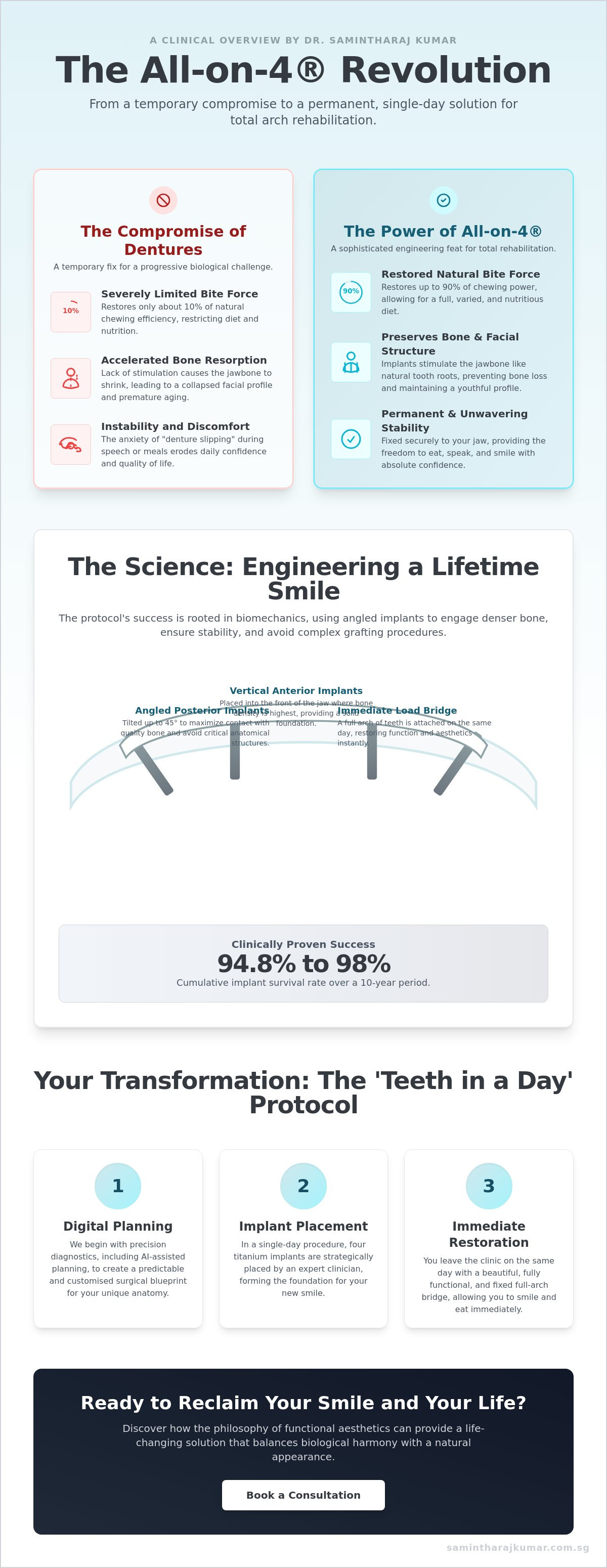
To address this, we utilise the All-on-4 treatment concept. This is a sophisticated surgical engineering approach designed for full-arch rehabilitation. By using four strategically placed implants, we can support a full set of fixed teeth, effectively bypassing the need for individual implants for every missing tooth. This protocol offers a permanent, stable alternative to the cycle of endless fillings and extractions that many patients have endured for years.
To better understand how we begin this transformative process, watch this helpful video:
The Limitations of Conventional Dentures
Conventional dentures were once the standard, but they often fail to meet the demands of a modern lifestyle. From a biological perspective, a removable denture only restores about 10% of your natural chewing efficiency. This limitation makes it nearly impossible to enjoy a varied, nutritious diet. I often hear from patients about the anxiety caused by "denture slipping" during speech or meals. Perhaps most importantly, dentures do nothing to prevent jawbone resorption. Without the mechanical stimulation that all on 4 dental implants provide, the jawbone naturally shrinks over time, leading to a collapsed facial profile and premature ageing.
The Evolution of Full-Arch Rehabilitation
The journey toward modern implantology has seen a dramatic shift from complex, multi-implant procedures to more streamlined protocols. Historically, the Malo Clinic protocol set the global standard for what we now call "Teeth in a Day." As a clinician and founder, I've embraced this evolution because it prioritises the patient's time and comfort. By tilting the posterior implants, we can often avoid the need for extensive bone grafting. This means the all on 4 dental implants process, which used to take twelve months of healing, can now be achieved in a single day. It's a visionary leap in how we deliver life-changing results and restore confidence almost instantly.
The Science of All-on-4: Why Four Implants Can Support a Full Arch
The success of all on 4 dental implants is rooted in sophisticated mechanical engineering. In my clinical experience, the protocol is a masterpiece of load distribution. We place two implants vertically in the anterior region and two at a strategic angle of up to 45 degrees in the posterior. This tilt is the cornerstone of the protocol. It allows us to utilise the denser bone found in the front of the jaw, providing immediate stability that traditional methods often lack. By increasing the bone-to-implant contact area, we create a robust foundation capable of supporting a full arch of teeth without the need for an implant at every tooth site.
From a biological perspective, this angulation is vital for patient safety. It enables me to navigate around critical anatomical landmarks, such as the maxillary sinuses in the upper jaw and the mental nerves in the lower jaw. This precision reduces the risk of surgical complications and accelerates the initial healing phase. Once the implants are in place, the critical process of osseointegration begins. This is where the jawbone physically fuses with the titanium or ceramic surface of the implant. It effectively turns the prosthetic into a permanent part of your anatomy, restoring up to 90% of your natural chewing function.
Eliminating the Need for Complex Bone Grafting
One of the most significant advantages of this approach is that it often bypasses the need for a bone graft. In conventional implantology, patients with significant bone loss would require months of grafting procedures before an implant could even be considered. By tilting the posterior implants, we harness your existing bone density. This not only reduces the total surgery time but also lowers the biological cost to your body and shortens your recovery period. It's a more efficient path to total rehabilitation.
AI and Digital Planning in 2026
In 2026, the margin for error has been virtually eliminated through AI-assisted diagnostics. As a clinician and founder, I've integrated 3D CBCT scans with AI path-mapping software to identify the optimal position for every implant with millimeter-level accuracy. We no longer rely solely on manual measurements. Instead, we use precision-guided surgery to ensure the outcome is predictable and stable. Digital Smile Design also allows us to pre-visualise your final aesthetic result before we even begin. This level of foresight ensures that your new smile is both functional and beautiful. If you're ready to explore how these technologies can benefit you, I invite you to learn more about our approach to full-arch rehabilitation.
Clinical Consequences and the Biological Imperative for Intervention
From a biological perspective, the moment a tooth is lost, the underlying alveolar bone begins a process of atrophy. Without the mechanical stimulation of a root, the body reabsorbs this bone tissue, leading to a 25% decrease in bone volume within just the first year. This is the silent consequence of terminal dentition. It isn't merely a matter of missing teeth; it's the gradual dissolution of the foundation that supports your entire facial structure. Choosing all on 4 dental implants isn't just a cosmetic decision. It's a medical intervention designed to halt this skeletal decline and restore the structural integrity of the jaw.
In my clinical experience, the psychological shift that occurs after rehabilitation is profound. Many of my patients have spent years 'surviving' with the limitations of failing teeth or loose dentures. They've adapted their diets, their speech, and even their social lives to accommodate their dental struggles. Moving to a fixed, permanent solution allows them to stop managing a disability and start thriving. It’s about more than a smile; it’s about reclaiming the freedom to live without constant dental anxiety.
Preserving Facial Architecture
When we lose bone volume, we lose the support for the soft tissues of the face. This leads to 'facial collapse,' where the distance between the nose and chin decreases, creating a sunken appearance and deep-set wrinkles. Full-arch restoration provides the necessary load to maintain jawbone volume, effectively supporting the lips and cheeks from within. By restoring the 'V-shape' of the lower face, we provide a form of internal rejuvenation that topical treatments cannot replicate. Waiting too long for this intervention often makes later rehabilitation more complex as the available bone diminishes.
Nutrition and Systemic Health
The link between oral health and systemic well-being is undeniable. Chronic oral inflammation contributes to the body's overall inflammatory load, which is a known risk factor for cardiovascular health. Beyond inflammation, there's the issue of nutrition. If you can't chew fibrous vegetables or lean proteins, your systemic health suffers. Statistics from 2026 indicate that implant-supported teeth restore up to 90% of natural bite force, allowing for a significantly more diverse diet compared to removable dentures. As a clinician and founder, I see all on 4 dental implants as a gateway to better longevity. When you can eat properly, your body receives the nutrients it needs to thrive. The best outcomes begin with understanding the root cause.
My Perspective: The Philosophy of Functional Aesthetics and Total Rehabilitation
In my clinical experience, the most successful outcomes are those that balance aesthetics with biological harmony. Too often, dentistry is viewed through a purely cosmetic lens, focusing only on the appearance of the teeth. However, as a clinician and founder, I view all on 4 dental implants as a tool for Total Rehabilitation. This isn't just about a bright smile; it's about restoring the mechanical and biological equilibrium of the entire oral-facial complex. My philosophy prioritises minimally invasive techniques that respect the body's natural architecture while ensuring long-term structural integrity. We aren't just fixing teeth; we're rebuilding a foundation for health.
The Nuffield legacy is built on this very principle of innovation and patient-centred care. We don't look at the jaw in isolation. We consider the whole patient. This includes their systemic health, their nutritional needs, and their long-term quality of life. By building an institution focused on these pillars, we've moved away from transactional dentistry toward a model of lifelong oral health. It's about creating a transformation that is as functional as it is beautiful.
The Nuffield Approach to All-on-4
I insist on a full mouth rehabilitation mindset for every case that enters our clinic. This means we don't just replace missing teeth; we rebuild the entire functional environment. From a biological perspective, this involves assessing bone quality and the health of the surrounding tissues with meticulous care. We frequently manage complex cases where patients have been told by other providers that they have "no bone left." By utilising advanced protocols, such as zygomatic or tilted implants, we can often provide solutions where others see none. If you're facing a complex dental challenge, you can consult with our specialist team to explore your options for total restoration.
Innovation and the Future of Care
My commitment has always been to bring global standards and Malo Clinic protocols to the national stage in Singapore. In 2026, I believe AI-assisted diagnostics have become the gold standard for surgical safety. By using AI to analyse 3D imaging, we can identify bone density variations and nerve pathways with a level of precision that was impossible even five years ago. This technology makes complex oral surgery more accessible and predictable for everyone. My vision for the future is one where the barrier of fear is replaced by a sense of security, knowing that every step of the all on 4 dental implants procedure is backed by data-driven precision and a mentor-like dedication to healing. The best outcomes begin with understanding the root cause.
The Journey to Transformation: What Patients Should Expect
In my clinical experience, the clarity of the surgical roadmap is what ultimately lowers the barrier of fear for most patients. The process begins with a comprehensive consultation where I perform a deep dive into your medical history and aesthetic aspirations. We utilize 3D imaging to create a precise digital twin of your anatomy, ensuring every aspect of the all on 4 dental implants procedure is planned before we even enter the theatre. On surgery day, we execute the 'Teeth in a Day' protocol. You arrive with failing dentition and leave with a fixed, functional provisional bridge that restores your smile and confidence immediately.
The transition period typically lasts between three to six months. This is a vital biological phase where osseointegration occurs, allowing the titanium or ceramic implants to become a permanent part of your jawbone. Once this foundation is secure, we transition to the final restoration. As a clinician and founder, I oversee the crafting of a bespoke, permanent bridge, often utilizing monolithic zirconia for its superior strength and natural translucency. This final prosthetic is designed to match your specific facial proportions, ensuring a result that is both biologically harmonious and aesthetically seamless.
The All-on-4 Recovery Process
Understanding the all on 4 recovery timeline is essential for a smooth transformation. In the first 72 hours, you may experience mild swelling or bruising, which we manage with precise post-operative protocols. From a biological perspective, the primary goal during the first few weeks is protecting the implants while they begin to fuse with the bone. I advise a soft food diet during this phase to avoid excessive mechanical stress. Most patients find they can return to their professional lives within three to five days, feeling a renewed sense of comfort and stability that dentures simply cannot provide.
Long-term Maintenance and Quality of Life
These implants are designed to be a lifetime solution. Data from 2026 indicates a 15-year survival rate of 94% to 96%, with a recent study in the Journal of Functional Biomaterials reporting a failure rate of just 2.17%. While the implants themselves are permanent, the prosthetic bridge requires diligent care. A monolithic zirconia bridge can last between 15 to 20 years with proper maintenance. This includes regular professional cleanings and a committed home care routine, similar to how you would treat natural teeth. My vision for every patient is a life free from dental embarrassment, where the focus shifts from survival to a high quality of life. The best outcomes begin with understanding the root cause.
Reclaiming Your Vitality through Precision Rehabilitation
The transition from terminal dentition to a permanent, fixed smile is a pivotal moment in your health journey. We've explored how all on 4 dental implants represent more than just a dental procedure; they're a sophisticated biological and engineering solution designed to preserve your facial architecture and systemic well-being. As the founder of Nuffield Dental and a specialist in zygomatic and complex implantology, I've dedicated my career to refining these protocols. By adhering to international Malo Clinic standards, I ensure that even the most challenging cases receive a level of care that's both world-class and deeply personal.
In my clinical experience, the transformation is about reclaiming the freedom to live without hesitation. The move to a permanent, fixed bridge is a life-changing event that replaces the discomfort of the past with the security of modern science. I believe every patient deserves a future where their oral health supports their long-term longevity and social confidence. The right diagnosis changes everything. Begin your journey toward total rehabilitation with a specialist consultation.
The best outcomes always begin with understanding the root cause.
Frequently Asked Questions
How long do All-on-4 dental implants last?
All-on-4 dental implants are engineered to be a lifetime solution for the majority of patients. In my clinical experience, the titanium implants themselves maintain a 15-year survival rate between 94% and 96%. While the underlying foundation is permanent, the prosthetic bridge has its own lifespan. A high-quality monolithic zirconia bridge typically lasts 15 to 20 years before requiring replacement. Regular maintenance is the key to ensuring this longevity and protecting your investment in your health.
Is the All-on-4 procedure painful?
Most patients experience very little discomfort during the procedure due to our sophisticated anaesthesia and sedation protocols. As a clinician and founder, I prioritise your comfort through minimally invasive techniques and precision digital planning. This reduces surgical trauma significantly. While you may feel some minor swelling or tenderness in the first 72 hours, this is easily managed with our standard post-operative care instructions. Most individuals find the experience much easier than they initially anticipated.
Am I a candidate for All-on-4 if I have severe bone loss?
Severe bone loss does not necessarily disqualify you from receiving all on 4 dental implants. One of the primary advantages of this protocol is the 45-degree tilting of posterior implants, which allows us to utilise your existing bone density. From a biological perspective, this often eliminates the need for complex grafting. In cases of extreme maxillary atrophy, I may employ zygomatic dental implants to achieve stability, ensuring that total rehabilitation remains a viable option for almost every patient.
What is the difference between All-on-4 and traditional implants?
The primary difference lies in the number of implants used and the strategic angulation of the posterior fixtures. Traditional full-arch restorations often require six to eight implants and lengthy bone grafting procedures. In contrast, the All-on-4 approach uses just four implants to support a full bridge. By tilting the back implants, we maximise bone contact and avoid critical structures. This streamlined engineering allows for a faster recovery and a more cost-effective path to a permanent smile.
How do I clean and maintain my All-on-4 implants?
Maintaining your new smile is straightforward and mirrors the care required for natural teeth. You should brush twice daily and use a water flosser to clean beneath the bridge where it meets the gumline. I also insist on professional cleanings every six months at Nuffield Dental to monitor the health of the surrounding tissue. Preventing peri-implantitis is essential for long-term success. Diligent home care ensures your implants remain a healthy, functional part of your anatomy.
Can I really get new teeth in just one day?
You can indeed walk out with a fixed set of functional teeth on the same day as your surgery. Our 'Teeth in a Day' protocol involves placing a high-quality provisional bridge immediately after the all on 4 dental implants are secured. This allows you to eat, speak, and smile with confidence while the osseointegration process occurs over the following three to six months. We then craft your bespoke, permanent bridge once the healing phase is complete.
What is the success rate of All-on-4 dental implants?
The cumulative success rate for this procedure is remarkably high, typically ranging between 94.8% and 98% over a ten-year period. A 2026 report in the Journal of Functional Biomaterials even noted failure rates as low as 2.17% when performed by experienced specialists. These statistics reflect the predictable nature of modern implantology. As a clinician, I believe these outcomes are the result of meticulous digital planning and a strict adherence to international surgical protocols.
How much do All-on-4 dental implants cost in Singapore?
The total investment for full-arch rehabilitation depends on the complexity of your case and the materials chosen for your final prosthetic. While average costs in the UK range from £15,000 to £25,000 per arch, I focus on providing a quietly premium service that reflects specialist expertise and global standards. The best outcomes begin with understanding the root cause, and a detailed consultation allows us to provide a transparent breakdown tailored to your specific biological needs and aesthetic goals.

Comments