
Can you claim Medisave for wisdom tooth surgery costs?

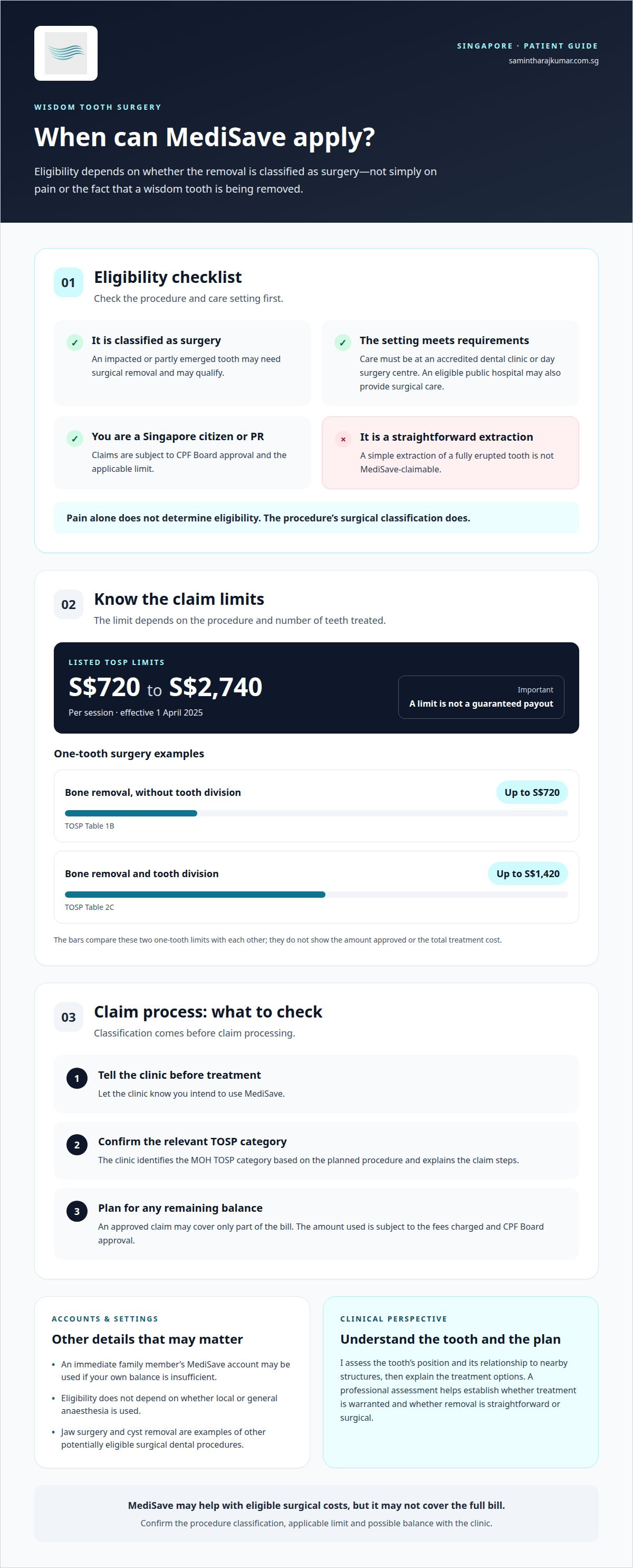
In Singapore, you can claim MediSave for wisdom tooth surgery only when the removal is classified as surgery; a routine extraction of a fully erupted tooth isn’t covered. The claim limit depends on the procedure and the number of teeth treated, with listed TOSP limits ranging from S$720 to S$2,740 per session, effective 1 April 2025.
It’s understandable to want clarity about costs before deciding on treatment. For wisdom tooth surgery, MediSave eligibility depends on how the procedure is classified, not simply on whether the tooth is painful.
Here’s when MediSave may apply, how the clinic submits a claim and what can affect the amount covered. I’ll also explain what wisdom tooth surgery and recovery can involve, and what to discuss with your dental professional if the remaining cost is a concern. The aim is to clarify the next steps so you can consider treatment with a better understanding of both the claim process and your care.
Table of Contents
The Problem: Wisdom Tooth Pain and the Cost of Treatment
Wisdom tooth discomfort can make eating, concentrating and sleeping harder. Deciding about treatment brings another concern: how much will you need to pay out of pocket? When pain affects daily life, it’s natural to want relief and clear information before deciding what to do.
“Wisdom tooth removal” can refer to different procedures. A fully emerged tooth may be removed with a straightforward extraction, while an impacted or partly emerged tooth may require surgery. The approach affects planning and clinical work, and determines whether MediSave may apply. Pain alone does not determine eligibility.
If you’re asking whether you can claim MediSave for wisdom tooth surgery, remember that an approved claim may cover only part of the cost. The claim limit depends on the surgical classification, and the amount used is also subject to the fees charged and CPF Board approval. You may need to plan for a remaining balance. If affordability is a concern, raise it early so the clinical plan, claim process and payment arrangements can be discussed together. Clear explanations help reduce uncertainty and support an informed decision without letting cost concerns replace an accurate assessment.
Why Wisdom Tooth Problems Happen
Wisdom teeth are the last molars to emerge, usually appearing between the ages of 17 and 21. Their position at the back of the mouth can make their development less straightforward: a tooth may emerge at an angle, remain partly beneath the gum, or stay enclosed within the jaw. The available space and the tooth’s direction of growth influence how it comes through.
In my clinical experience, a tooth that only partly emerges can be difficult to keep clean. Food debris and plaque may collect around the gum covering it, causing tenderness and irritation. A tooth growing towards its neighbour can also place pressure on the surrounding area. These changes may develop gradually, so discomfort is not always the first sign that the tooth’s position needs attention.
Not every wisdom tooth causes problems, and symptoms alone don’t show exactly what is happening beneath the gum. An examination and suitable imaging help establish the tooth’s position, its relationship to nearby teeth and surrounding structures, and whether treatment is warranted. The same complaint can arise from different patterns of eruption, so assessment guides the appropriate clinical approach. Understanding the cause helps you decide what to do based on the tooth’s condition, rather than pain alone.
Why MediSave Eligibility and Extraction Type Matter
In Singapore, MediSave eligibility depends on whether the removal is classified as surgery. The procedure type also determines the applicable claim limit.
Eligibility for Surgical Wisdom Tooth Removal
Eligibility means the extraction must qualify as a surgical procedure at an accredited dental clinic or day surgery centre. Singapore citizens and Permanent Residents may claim, subject to CPF Board approval and the applicable limit.
Coverage for Impacted Teeth
An impacted wisdom tooth that needs surgery may qualify; a simple extraction of a fully emerged tooth does not. For one tooth, TOSP Table 1B allows up to S$720 for bone removal without tooth division; Table 2C allows up to S$1,420 when bone removal and tooth division are required. Both limits are effective 1 April 2025.
Approval may cover only part of the bill, leaving an out-of-pocket balance. Using MediSave does not remove that possibility.
Eligible Dental Procedures and Care Settings
Eligible surgical care may take place at a public hospital if the procedure and facility meet MediSave requirements. Other examples of potentially eligible surgical dental procedures include jaw surgery and cyst removal.
Rules for Wisdom Tooth Extraction Claims
For eligible surgical removal, limits depend on the operation and number of teeth treated. A patient may use an immediate family member’s account if their own balance is insufficient. If costs are difficult, discuss payment arrangements with the dental clinic.
My Treatment Philosophy for Wisdom Tooth Surgery
My Wisdom Tooth Surgery is a considered next step when a wisdom tooth is impacted, difficult to clean, or causing symptoms that need clinical assessment. I begin by understanding the tooth’s position and how it relates to nearby structures, then explain the treatment options in clear terms. The aim is a plan that reflects the clinical findings, rather than pain or cost concerns alone.
Patients are better prepared when they understand why an extraction may be straightforward or require surgery. That distinction also matters for MediSave: eligibility depends on the procedure’s surgical classification, not simply on discomfort. Before deciding, understand the expected approach, the claim process and the possibility of an out-of-pocket balance.
Consider a professional assessment if discomfort is affecting daily activities, a wisdom tooth has not fully emerged, or you want to know whether treatment is appropriate. The reasoning behind care should be as clear as the care itself. An informed decision starts with understanding the tooth and the options available. To discuss your situation, contact me.
What Patients Can Expect: The MediSave Claim Process and Surgery
MediSave processing begins with clinical classification; authorisation and recovery are also part of the process. Eligibility follows the surgical classification, not whether local or general anaesthesia is used.
Claim Forms and Clinic Processing
Before treatment, tell the clinic you intend to use MediSave. The clinic identifies the relevant MOH TOSP category based on the planned procedure and explains the claim steps. A simple extraction of a fully erupted tooth isn’t MediSave-claimable. Surgery may qualify if it meets the requirements. The classification, rather than the broad label “wisdom tooth removal,” guides the claim.
Claim Authorisation and Documents
The patient or an immediate family member whose account will be used signs a MediSave Claims Authorisation Form (MCAF). Bring your NRIC on the day of surgery. The clinic submits the claim to CPF on your behalf. The amount remains subject to the applicable limit and CPF Board approval. This authorises use of the account for the classified procedure and helps clarify any balance payable outside MediSave.
For surgery, the dentist makes an incision in the gum; the tooth may be divided for removal. Swelling can peak on days 2-3 and settle within a week. Avoid brushing the surgical area for 24 hours after extraction. Recovery depends on the procedure’s complexity.
The Long-Term Impact of Timely Wisdom Tooth Care
Timely wisdom tooth care is not simply about removing a tooth quickly. It means understanding the tooth’s position, noticing changes and choosing a proportionate response before discomfort becomes a recurring part of daily life.
A clear diagnosis is the starting point. It helps distinguish a tooth that can be observed from one whose position or symptoms warrant treatment. The plan can then reflect clinical need, rather than anxiety or assumptions about future problems.
A tooth that repeatedly causes soreness can interfere with eating and concentration. If it is difficult to clean because it has only partly emerged, the surrounding gum may stay irritated. Timely assessment allows the dentist to review the tooth and nearby structures, explain any changes, and discuss whether observation or removal is appropriate. The goal is a reasoned decision, not automatic surgery.
Financial planning belongs alongside clinical reasoning, but it should not dictate treatment. Understanding the procedure and its MediSave classification can help you plan for any payable balance while keeping clinical need central.
My Perspective on Wisdom Tooth Surgery
As a clinician and founder, I see wisdom tooth care as an opportunity to make healthcare more thoughtful and patient-centred. A good decision is not defined by how quickly it is made, but by whether the person understands the reasoning and feels able to take part in it. That sense of partnership matters.
A clinician’s responsibility is to explain what an assessment shows, listen to the concerns behind your questions and make the choices understandable. You may be weighing discomfort, work, family responsibilities and personal priorities alongside clinical advice. Respectful care makes room for these considerations without losing sight of the clinical purpose.
Trust is built through clear reasoning and accountability. In oral surgery, precision is not only technical; it also means paying attention to what matters to each patient. The future of healthcare should bring stronger diagnostics and better decisions while preserving the human conversation at the centre of care. The aim is informed patients, considered treatment and care shaped around long-term wellbeing.
Understanding whether you can claim MediSave for wisdom tooth surgery is one part of making a considered decision. Bring the clinical and financial questions into the same conversation so the treatment plan reflects your needs and you understand what comes next. A clear discussion can turn uncertainty into a practical way forward.
You should feel able to ask why a particular approach is being considered and how it may affect daily life. Openness supports trust, informed choices and care guided by more than immediate discomfort. The right decision begins with understanding your situation, not feeling rushed.
If you would like to discuss wisdom tooth care with me, you can contact me. I welcome a thoughtful conversation about your concerns and the options relevant to your care. Taking the next step with clear information can help you move forward with greater confidence.
Frequently Asked Questions
How Much Can I Claim with MediSave?
The amount varies with the operation and the number of teeth treated. For surgery involving two or three teeth, TOSP Table 3B allows up to S$2,040 when bone is removed without tooth division; Table 3C allows up to S$2,220 when both are involved. The listed totals include a S$300 surgical consumables allowance per session. These figures are limits, not a promise of payment.
How Is the MediSave Table Determined for Your Case?
The applicable table corresponds to the operation carried out, including how many teeth are treated and the surgical work required. For example, four teeth requiring bone removal without division fall under Table 4A, with a limit of S$2,680; with division, Table 4B allows up to S$2,740. The relevant category reflects the documented procedure, rather than a patient’s preferred table.
Q5: How soon will the MediSave deduction be reflected?
After processing, the MediSave deduction should appear in the account within a few days to a week. Check your account activity after treatment, but remember that the deduction is not immediate confirmation of the final amount payable. The claim remains subject to the applicable limit, fees and CPF Board approval.
What Criteria Must I Fulfil to Qualify for MediSave?
The patient must be a Singapore citizen or Permanent Resident, and the procedure must meet MediSave’s surgical requirements. A practical point is identifying whose account will fund the claim: if an immediate family member’s account is used, that account holder signs the authorisation form. This helps the clinic submit the claim using the intended account and avoids confusion about whose MediSave balance is involved.
Which Procedures Qualify?
Selected complex dental procedures involving surgery for medical reasons may qualify under the applicable day-surgery withdrawal limits. Examples include wisdom tooth surgery, dental implants, jaw surgery and cyst removal. If all four wisdom teeth require surgical extraction, a claim may be made for each tooth, subject to the relevant limits and approval. The number treated can affect the applicable claim category.
Can Singapore MediSave be used for wisdom tooth surgery?
Yes. MediSave may be used for qualifying surgical wisdom tooth removal in Singapore, including at a participating private dental clinic. A straightforward extraction of a fully erupted tooth differs from an operation involving an impacted tooth. If several wisdom teeth need treatment, the number treated and the surgical work performed shape the claim category and applicable limit.
Comments