
False Teeth in Singapore: A Specialist’s Comparison of Dentures and Total Rehabilitation (2026)

What if the most common solution for missing teeth is actually the one that accelerates the aging of your facial profile? In my clinical experience, many patients view traditional dentures as a final destination, yet they often struggle with the hidden reality of progressive bone resorption and the persistent anxiety of prosthetic instability. If you're currently researching options for false teeth in Singapore, you likely want more than just a cosmetic fix. You're looking for the biological stability to speak clearly and the functional freedom to eat without restriction.
I promise to provide a transparent, specialist-led comparison between conventional removable appliances and the transformative precision of total arch rehabilitation. My goal is to help you understand the long-term clinical consequences of each choice, ensuring you can regain your confidence with a solution that respects your oral anatomy. We'll examine the science of jawbone preservation, the mechanics of implant-supported stability, and the specific protocols that allow for a seamless transition to a permanent, natural-looking smile.
Key Takeaways
Understand why modern false teeth in Singapore have evolved from simple removable plates into high-grade ceramic prosthetics that mimic natural aesthetics and function.
Explore the biological impact of tooth loss and how advanced implant-supported rehabilitation prevents the long-term jawbone resorption associated with traditional dentures.
Compare the true value of various restorative paths by evaluating the initial investment against the decade-long maintenance requirements of each clinical option.
Learn how 3D CT diagnostics and specialised protocols enable total rehabilitation even for patients who have previously been told they lack sufficient bone volume.
Discover my clinical philosophy on patient-centred care, where international safety standards and long-term quality of life are the primary measures of success.
Table of Contents Understanding False Teeth: From Traditional Dentures to Modern Prosthetics The Biological Perspective: Why the Root Cause of Tooth Loss Matters Comparing Your Options: Dentures vs. Dental Implants in Singapore Assessing Suitability: Bone Volume, Quality, and Lifestyle Factors My Philosophy on Total Rehabilitation and Long-Term Quality of Life
Understanding False Teeth: From Traditional Dentures to Modern Prosthetics
In my clinical experience, the term "false teeth" often evokes outdated images of removable plates soaking in a glass overnight. As we move through 2026, the reality of false teeth singapore has shifted toward a sophisticated discipline of oral rehabilitation. We no longer view prosthetics as mere placeholders. Instead, we treat them as bio-compatible extensions of the human body. From a biological perspective, the goal of modern treatment is to restore the delicate harmony between form, function, and biology. This involves a deep understanding of how Understanding False Teeth has evolved from basic utility to high-grade ceramic engineering.
To better understand the craftsmanship behind modern prosthetics, watch this helpful video:
The complexity of modern rehabilitation means we must look beyond the surface. Aesthetics are now driven by digital smile design and monolithic zirconia, materials that mimic the light-reflective properties of natural enamel. When I design a prosthetic for a patient, I'm not just replacing teeth. I'm reconstructing the vertical dimension of their face and supporting the underlying soft tissues to provide a life-changing transformation.
The Traditional Approach: Removable Dentures
Removable options remain a valid entry-level solution for many patients in Singapore. Partial dentures typically address specific gaps, while full dentures replace an entire arch. We often use high-impact acrylics or cobalt-chrome frameworks to provide structural integrity. While these traditional methods are cost-effective, they require a patient to adapt to the limitations of mucosal support. They serve as a vital first step for those who may not be immediate candidates for surgery but still require functional restoration.
The Modern Standard: Implant-Supported Fixed Teeth
The clinical gold standard has transitioned toward fixed prosthetics. These systems are either "snapped" onto or permanently screwed into titanium or ceramic posts. By utilizing a dental implant singapore, we can prevent the bone resorption that typically follows tooth loss. Modern protocols, such as "Teeth in a Day," allow us to provide a fixed bridge in a single surgical session. This approach offers a level of stability and confidence that traditional removable plates simply cannot match.
My Perspective: The Founder’s Insight
As a clinician and founder, I've observed that the most successful outcomes occur when we stop treating teeth in isolation. Total rehabilitation is about the ecosystem of the mouth. In my practice, I prioritize the use of AI-assisted diagnostics to ensure that every prosthetic is aligned with the patient’s unique jaw kinetics. It's about precision. When we combine specialist expertise with global standards like the Malo Clinic protocols, we move away from the "false" nature of prosthetics and toward a result that feels entirely natural. The best outcomes begin with understanding the root cause, ensuring that the new smile is built on a foundation of long-term health and stability.
The Biological Perspective: Why the Root Cause of Tooth Loss Matters
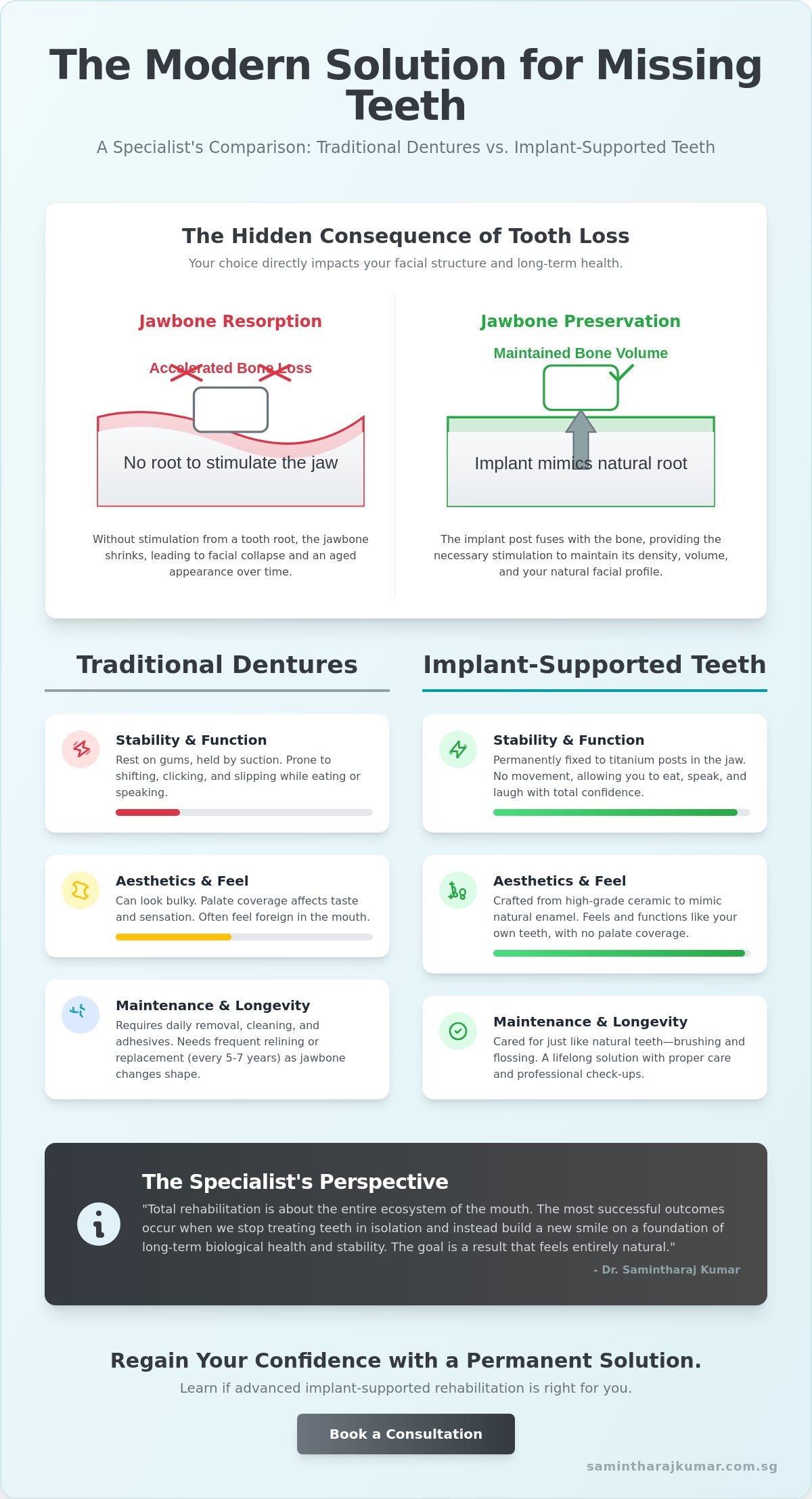
In my clinical experience, patients seeking false teeth in Singapore often focus on the immediate aesthetics of their smile. While a visible gap is certainly a valid concern, the most significant changes occur silently beneath the gum line. When a tooth is lost, the jawbone no longer receives the mechanical stimulation it requires to maintain its density and volume. From a biological perspective, the jawbone exists solely to support teeth; without a root to transmit biting forces, the body begins to reabsorb the minerals from that area.
Many patients believe that traditional removable options solve the problem entirely. However, these appliances can actually accelerate bone loss. Because they sit on the gum tissue, they exert constant, unnatural pressure on the underlying bony ridge. This pressure causes the bone to recede faster than if no appliance were worn at all. Over time, this leads to the "sunken" facial appearance and loss of lip support that many associate with ageing. Transitioning from Traditional Dentures to Modern Prosthetics allows us to address these structural issues more effectively by considering the health of the entire maxillofacial complex.
My Perspective: The Importance of the Tooth Root
As a clinician and founder, I view the tooth root as the foundation of facial architecture. Modern implants are designed to mimic this natural root, using biocompatible materials like titanium and ceramic to facilitate osseointegration. This process allows the bone to fuse directly with the implant, ensuring the jawbone remains stimulated and healthy. I prioritise preserving bone volume from the very first consultation. It's far more predictable to maintain existing bone than to rebuild it through extensive grafting procedures years later. My goal is always to provide a solution that feels seamless and functions like a natural part of your biology.
Clinical Consequences of Delayed Rehabilitation
Delaying treatment for missing teeth often leads to a "domino effect" in the oral cavity. When a gap is left vacant, adjacent teeth frequently shift and tilt into the empty space. This migration disrupts your natural bite alignment and can lead to chronic TMJ health issues and muscle tension. Bone resorption is the inevitable physiological response to tooth root absence. Waiting too long to replace false teeth in Singapore makes future surgery more complex, as there may be insufficient bone to support standard implants. The best outcomes begin with understanding the root cause, and I invite you to learn more about how total rehabilitation can preserve your facial structure and quality of life.
Comparing Your Options: Dentures vs. Dental Implants in Singapore
In my clinical experience, patients seeking false teeth in Singapore often find themselves at a crossroads between traditional removable options and modern fixed solutions. I categorise these into three distinct paths. Traditional dentures offer a non-invasive entry point. Dental bridges serve as a middle ground for smaller gaps. Dental implants represent the gold standard for total arch rehabilitation. Each path carries specific biological and lifestyle implications that reach far beyond the dental chair.
From a biological perspective, the difference in bite force efficiency is staggering. A traditional removable denture typically provides only 20% of the chewing power found in natural teeth. In contrast, dental implants often achieve 90% or more. This isn't just about your ability to enjoy a meal; it's about the preservation of the jawbone. Without the root-like stimulation provided by implants, the bone begins to resorb. This process eventually alters your facial structure and makes the denture fit increasingly poorly over time.
When evaluating the "True Cost" of these treatments, we must look at a 10-year horizon. While dentures have a lower initial price, the cumulative cost of maintenance, professional relining, and eventual replacement adds up. Implants require a higher upfront investment but offer a permanent foundation that respects the integrity of your remaining oral anatomy.
Maintenance and Longevity
I frequently observe that dentures require relining or complete replacement every 5 to 7 years. This is because the underlying bone changes shape as it recedes. In contrast, correctly placed and maintained dental implants have a lifetime potential. Hygiene rituals also differ significantly. While dentures require nightly removal and specialised soaking, fixed implants are integrated into your daily brushing and flossing routine, offering a seamless transition for your lifestyle.
The Aesthetics of a Natural Smile
We avoid the "denture look" through meticulous digital smile design and the use of premium ceramic materials. In my practice, we don't just replace teeth; we focus on facial rejuvenation. By using customised tooth positioning, we ensure the prosthetic supports the lips and cheeks correctly. This prevents the sunken appearance often associated with long-term tooth loss. The goal is a smile that looks, feels, and functions as if it were your own.
My Perspective
As a clinician and founder, I believe the true value of a smile lies in the confidence it restores. I've seen patients transform from being socially withdrawn to vibrant and active because they no longer fear their false teeth in Singapore slipping during a conversation. While the initial journey toward total rehabilitation is more complex, the long-term impact on your quality of life is incomparable. The best outcomes begin with understanding the root cause of your dental concerns and choosing a solution that aligns with your long-term health goals.
Assessing Suitability: Bone Volume, Quality, and Lifestyle Factors
In my clinical experience, the most critical phase of rehabilitation isn't the surgery itself; it's the diagnostic precision that precedes it. Before I recommend any form of false teeth singapore patients might consider, a 3D Cone Beam Computed Tomography (CBCT) scan is mandatory. This technology allows me to visualise the alveolar bone in three dimensions, identifying its height, width, and density with sub-millimetre accuracy. Choosing a dental clinic that skips this step risks implant failure or avoidable complications.
I frequently meet patients who have been told they aren't candidates for implants due to bone resorption. From a biological perspective, bone loss is a natural consequence of missing teeth, but it's rarely an absolute barrier in 2026. Advanced oral surgery allows us to reconstruct what's lost. However, systemic health must be managed. For instance, poorly controlled diabetes can hinder osseointegration, while smoking increases the risk of implant failure by approximately 11%. We don't just look at your mouth; we look at your entire physiology.
Hope for Complex Cases
For severe upper jaw atrophy, I often utilise Zygomatic and Pterygoid implants. These specialised fixtures anchor into the cheekbone or the stable bone behind the upper jaw, bypassing the need for extensive grafting in many cases. The All-on-4 protocol remains a gold standard for full-arch rehabilitation, supporting a fixed bridge on four strategically tilted implants. While some view bone grafting as a complication, I view it as a routine preparatory step to ensure the long-term stability of your new smile. As a clinician and founder, my goal is to provide a foundation that lasts decades, not just years.
Lifestyle and Patient Preference
High-quality dentures remain a viable choice for those who prefer non-surgical options or have medical contraindications to surgery. Yet, the psychological difference is profound. Fixed teeth feel like a part of you; they don't move when you speak or require removal at night. This restores a level of confidence that traditional prosthetics often cannot match. In the context of false teeth singapore, the choice often comes down to how you wish to live your daily life. The best outcome begins with understanding the root cause of your specific dental condition.
The right diagnosis changes everything. Explore total rehabilitation options with a specialist perspective.
My Philosophy on Total Rehabilitation and Long-Term Quality of Life
In my clinical experience, the restoration of a smile is never just a matter of dental mechanics. It's about restoring a person's dignity, social freedom, and systemic health. When patients seek false teeth in Singapore, they often arrive focused on the immediate aesthetic gap. However, as a clinician and founder, I view every case through the lens of Total Rehabilitation. This approach isn't merely about filling spaces; it's about the biological integration of function and form. Since I established Nuffield Dental in 2014, we've remained committed to the Malo Clinic protocols. These international standards ensure that patient safety and comfort are the foundation of every procedure, not an afterthought.
I advocate for Total Rehabilitation because it represents a life-changing investment rather than a temporary fix. Traditional dentures often lead to bone resorption over time, but a fixed, implant-supported solution preserves the jaw structure. The transformative power of a stable, functional smile cannot be overstated. It changes how you eat, how you speak, and ultimately, how you present yourself to the world. We aren't just fixing teeth; we're rebuilding the framework for a high-quality life.
What to Expect in Your Consultation
The journey begins with a meticulous, sequential process. We utilize AI-assisted 3D diagnostics to map your jaw's density and nerve pathways with precision. This data allows our collaborative team, comprising oral surgeons and restorative specialists, to design a bespoke treatment plan. We don't believe in siloed care. By having the surgical and restorative teams work in unison, we ensure the final result is both structurally sound and aesthetically natural. The right diagnosis changes everything.
The Future of Dental Innovation
The landscape of restorative dentistry is shifting rapidly. In 2026, AI-driven design and 3D printing have made the creation of false teeth in Singapore more precise than ever before. We're now able to mill prosthetics with micron-level accuracy, which has reduced chair-side adjustment times by approximately 40% compared to five years ago. This technology allows for a seamless fit that was previously unattainable.
My vision for the future is a nation where tooth loss no longer limits one's quality of life. As we continue to innovate at Nuffield, our goal remains the same: to provide a legacy of healthy, beautiful smiles that last a lifetime. A stable smile is the cornerstone of longevity and confidence. The best outcomes begin with understanding the root cause.
Restoring Your Quality of Life through Total Rehabilitation
In my clinical experience, the journey toward restoring a smile involves more than just replacing missing teeth; it requires a deep understanding of the underlying biological structures. Whether we're addressing bone volume through zygomatic protocols or implementing All-on-4 techniques, my focus remains on long-term stability rather than temporary fixes. Traditional options for false teeth singapore often fail to address the bone resorption that follows tooth loss. This is why I advocate for a philosophy of total rehabilitation that prioritises the integrity of your jaw and facial structure.
As a clinician and the founder of Nuffield Dental Holdings, I've integrated global standards from my clinical presence in Singapore and London to ensure every procedure reflects the highest tier of surgical precision. We don't just aim for aesthetic improvement; we strive for a seamless transformation that respects your unique physiology. Choosing between dentures and modern prosthetics is a significant decision that impacts your daily comfort for decades. My goal is to guide you toward a solution that feels natural and provides the security you deserve. The best outcomes begin with understanding the root cause. Explore Total Rehabilitation with Dr. Samintharaj Kumar
Frequently Asked Questions
What is the average cost of false teeth in Singapore for 2026?
In my clinical experience, the cost of false teeth singapore patients encounter depends heavily on the material and the complexity of the rehabilitation. According to 2024 Ministry of Health data, public sector prices for a single acrylic denture range from $480 to $850. In my private practice, we focus on high-precision materials and digital workflows, which influences the investment required for a bespoke, long-term solution.
How long does it take to get used to wearing new dentures?
Most patients require an adaptation period of 4 to 8 weeks to feel fully comfortable with a new prosthetic. During the initial 14 days, you'll likely experience increased salivation and minor speech changes as your tongue adjusts to the new contours. I always advise starting with softer foods to help your oral musculature build the necessary coordination for efficient chewing and stability.
Can I switch from removable dentures to permanent dental implants later?
Yes, transitioning from removable dentures to permanent dental implants is a common pathway for my patients seeking improved stability. This process involves assessing bone density, as long-term denture wear can lead to 40 percent bone resorption within the first year of tooth loss. If bone volume is insufficient, I utilize specialized protocols like zygomatic implants or bone grafting to ensure a secure foundation.
Is the procedure for dental implants painful for older patients?
Modern implant surgery is designed to be a comfortable experience, even for patients in their 70s or 80s. We use precise local anaesthesia and often intravenous sedation to ensure you remain relaxed throughout the procedure. Post-operative discomfort is typically managed effectively with standard analgesics; 95 percent of my patients report that the sensation is much less intense than a routine tooth extraction.
How do I clean and maintain my false teeth to make them last?
To maintain the longevity of your false teeth singapore, you must clean them at least twice daily using a soft-bristled brush and non-abrasive cleanser. Avoid using standard toothpaste, as its abrasive particles can create microscopic scratches that harbour bacteria. I recommend soaking your dentures in a dedicated solution overnight to eliminate 99.9 percent of oral pathogens and allow your gum tissues to rest.
Will my insurance or MediSave cover the cost of dentures or implants in Singapore?
MediSave is applicable for the surgical components of dental implants, with current Ministry of Health withdrawal limits ranging from $350 to $2,150 per implant. Unfortunately, removable dentures don't qualify for MediSave as they aren't surgical procedures. I always recommend that patients review their private insurance schedules, as some premium international plans cover up to 70 percent of restorative dental costs.
What happens if my dentures feel loose or cause mouth ulcers?
If your dentures feel unstable or cause painful ulcers, it's a sign that the prosthetic requires a professional reline or adjustment. Ill-fitting dentures can lead to chronic inflammation and accelerated bone loss if left unaddressed. In my practice, I use digital scanning to identify pressure points with sub-millimetre precision, ensuring we restore a comfortable, seamless fit that protects your underlying bone tissue.
Are ceramic implants better than titanium for replacing missing teeth?
Ceramic implants offer a superior aesthetic and biological profile for patients with thin gum biotypes or metal sensitivities. From a biological perspective, zirconia is highly biocompatible and demonstrates significantly lower bacterial adhesion compared to titanium alloys. While titanium remains the industry standard with a 98 percent success rate over 10 years, ceramic is an excellent, metal-free alternative for a holistic approach to rehabilitation.

Comments