
Financing Major Dental Work in Singapore: Costs and Terms

Low monthly repayments can make major dental treatment seem manageable, while making the total borrowing cost easy to overlook. A dental loan is money borrowed to pay for care and repaid over an agreed term, with interest and fees determined by the financing arrangement. When considering financing major dental work in Singapore, look beyond the instalment: the total amount repayable and what insurance or eligible schemes cover both matter.
It’s reasonable to want to understand the treatment plan and payment plan together. In my clinical experience, clear decisions start with knowing what each option does, and what it may cost over time. I’ll explain how dental loans and promotional financing work, why promotional offers can depend on credit approval, and how interest rates and repayment periods affect the overall commitment.
You’ll also learn how insurance limits and Singapore’s treatment subsidy options fit into the picture, so you can distinguish support for eligible care from borrowing that must be repaid. The aim is to give you a steadier basis for weighing your choices before committing to treatment and a financing arrangement.
Table of Contents
Problem
The cost of major dental work can feel difficult to discuss. I approach these conversations without judgement, explaining the clinical plan and financial questions separately so patients can consider both clearly.
Treatment Cost Conversations
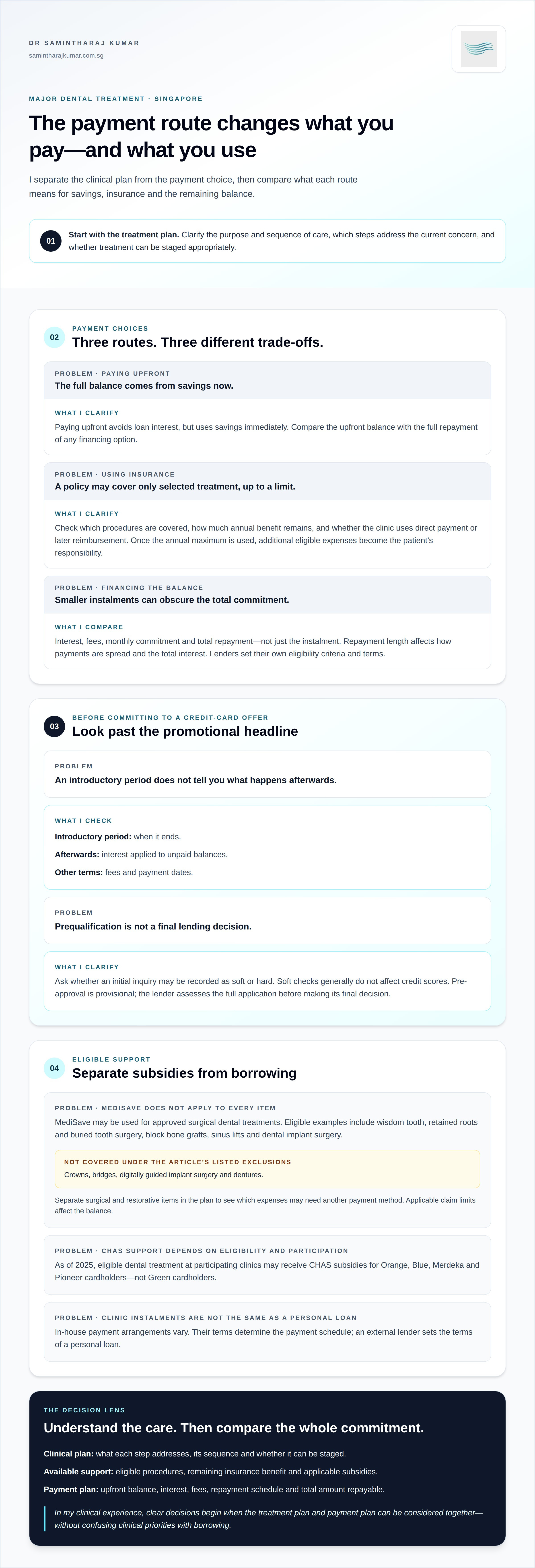
What to clarify: Understand the purpose and sequence of proposed care, then ask what postponement could mean clinically. Consider:
Which treatment steps address the current concern.
Whether care can be staged appropriately.
How the plan relates to a financing application.
Personal Loans for Dental Treatment
An unsecured personal loan may be used for dental care without an asset as security. I encourage patients to compare the interest, fees, total repayment and monthly commitment. A credit card is another possible route, but its promotional period and later interest can affect the balance.
Subsidies and MediSave for Major Procedures
Singapore subsidies and MediSave may help with eligible care. MediSave applies to approved surgical dental treatments, including dental implant surgery; crowns and dentures are excluded. The Ministry of Health says claim forms can be submitted to MediSave-accredited dental clinics for approved treatment.
CHAS Coverage and Clinic Payment Plans
As of 2025, eligible dental treatment at participating clinics may receive CHAS subsidies for Orange, Blue, Merdeka and Pioneer cardholders, but not Green cardholders. Clinic payment arrangements vary; an in-house instalment plan is distinct from a personal loan, and its terms determine the payment schedule.
Why It Happens
Financing major dental work in Singapore depends on the provider, product terms and application assessment.
Credit Card Dental Financing
I help patients look beyond a promotional headline. Promotional credit-card offers may include an introductory period, so check when it ends. I suggest comparing:
Introductory period: when it ends.
Afterwards: the interest applied to unpaid balances.
Other terms: fees and payment dates.
Eligibility and Credit History
Lenders may assess credit history, income and existing commitments. These factors can affect eligibility, approval and the terms offered.
Prequalification and Credit Inquiries
Distinguish an initial prequalification from a full application. Before proceeding, find out whether an inquiry may be recorded as soft or hard.
Soft Checks and Pre-Approval
Soft checks generally don’t affect credit scores. Pre-approval is provisional: the lender assesses the full application before making its final decision.
Interest Rates and Fees
Banks and payment providers in Singapore set product-specific rates and fees. Compare interest, charges and total repayment, not just monthly payments.
Loan Amounts and Repayment Terms
I help patients relate the requested amount to the treatment plan and available savings. Repayment length affects how payments are spread and total interest.
External Financing Reimbursement Terms
With external financing, practices submit charges when treatment is performed and follow the reimbursement terms in the financing contract.
Why It Matters
I help patients map insurance and payment choices against the treatment plan. The remaining balance depends on eligible procedures, policy limits and available funds.
Insurance Coverage and Annual Maximums
What I clarify: Dental insurance may cover selected procedures up to an annual maximum. Once that limit is used, additional eligible expenses become the patient’s responsibility. I encourage patients to identify:
Which procedures the policy covers.
How much benefit remains.
How the clinic’s accepted insurance arrangements apply, including direct payment or later reimbursement.
Paying Upfront, Using Insurance, or Financing
I help patients weigh the trade-offs rather than focus only on instalments:
Paying upfront avoids loan interest but uses savings immediately.
Insurance reduces costs only for covered treatment within its limits.
Financing spreads the balance over time, but interest and fees can raise the total paid.
Compare the full repayment with the upfront balance.
MediSave Claims and Eligible Procedures
MediSave may subsidise eligible surgical procedures, including wisdom tooth, retained roots and buried tooth surgery, block bone grafts, sinus lifts and dental implant surgery. Crowns, bridges, digitally guided implant surgery and dentures are excluded. Separate surgical and restorative items in the plan to see which expenses may need another payment method and how applicable claim limits affect the balance.
Treatment Philosophy
In my clinical experience, clear reasoning should come before payment discussions. For major dental work, I begin with the diagnosis and explain which concerns I intend the treatment to address. I distinguish clinical priorities from choices that may be staged, so financial pressure does not blur the purpose of each step. My treatment plan should describe the proposed care clearly, not make borrowing feel inevitable.
Next, I explain suitable treatment pathways and their functional implications. For example, anyone considering dental implants needs to understand the clinical rationale, sequence and alternatives before weighing financing options. A person’s budget is part of planning, not a measure of how much they value their health. A clear discussion gives patients room to consider care and payment together.
Clinical decisions and lender decisions are separate. I explain the proposed treatment, while a lender sets its own eligibility criteria, interest and repayment terms. I encourage patients to compare the total commitment, not only a monthly instalment, and consider insurance or eligible support alongside personal savings. This keeps the focus on informed choice, appropriate care and long-term function.
What Patients Can Expect
I begin by understanding your concern and assessing your clinical condition. During the examination, I connect your symptoms with the clinical findings and any potential treatment needs. I then explain my recommended approach, its purpose and the sequence involved. If alternatives are clinically appropriate, I encourage you to ask how they differ in function and planning. This gives us a clear basis for discussing treatment before a financing application becomes part of the decision.
Next, I set out the proposed care in clear stages, showing which procedures are involved and how they relate to one another. I explain the expected payment responsibilities for the agreed treatment separately from the lender’s terms. Insurance or eligible MediSave support may affect the amount remaining, depending on the procedure and coverage. This gives you a clearer basis for deciding how much, if anything, to borrow.
If you apply, the financing provider assesses your eligibility and sets its own approval, interest and repayment terms. I recommend reading the repayment schedule, fees and total amount due before accepting. I keep the financing decision separate from my clinical recommendation: approval does not determine which treatment is suitable. A transparent sequence helps you make considered choices without letting a monthly payment alone shape your care.
Long-Term Impact
The long-term value of dental treatment is measured in function and daily comfort, not simply in completing a procedure. In my clinical experience, decisions are stronger when patients understand the intended outcome and the steps needed to maintain it. A financing arrangement should support a considered treatment plan, rather than pressure someone towards a choice based only on its monthly cost.
Timely assessment can clarify whether a concern needs attention now or can be monitored. That distinction matters: delaying care without understanding the clinical situation may narrow future options. Treatment planning also considers how teeth, bite and oral tissues work together. For example, addressing a damaged tooth is not only about appearance; chewing comfort and the stability of surrounding structures may also guide the approach.
Long-term planning includes care after treatment. Follow-up and preventive habits help clinicians monitor changes and support ongoing oral health. A realistic repayment commitment matters too, because financial strain can affect someone’s ability to sustain planned care. Consider clinical priorities, maintenance and broader financial wellbeing together. The aim is not to borrow more, but to make informed choices that support function, confidence and quality of life over time.
Dr Samintharaj Kumar
I can help when major dental treatment raises clinical and financial questions. I explain the diagnosis, proposed care and how treatment stages relate to function and oral health. My role is to make the clinical reasoning clear, so financing decisions can be considered alongside care rather than replace it.
For example, when dental implants are being considered, I explain the clinical factors that shape planning and how the proposed sequence supports function. I also distinguish the treatment plan from a lender’s eligibility decision, interest rate and repayment terms. These are separate questions, and clarity about each prevents a monthly instalment from becoming the only measure.
Patients can raise questions about diagnosis, alternatives, insurance or MediSave eligibility, and the balance they may need to plan for. I can explain the clinical aspects and distinguish them from details set by an insurer or financing provider, without presenting borrowing as a condition of treatment. If complex implant care is part of the discussion, the focus remains on suitability and long-term function. For a considered conversation about your treatment plan, contact me.
Frequently Asked Questions
What is a dental loan?
I describe a dental loan as borrowing used to pay for dental treatment, with repayment governed by the lender’s agreement. It may be a personal loan used for care rather than a separate dental product. I encourage patients to read the agreement for the interest rate, fees, repayment schedule and consequences of missed payments. This helps you understand the financial commitment beyond the amount initially borrowed.
Do I need insurance to qualify for financing?
In my view, insurance and financing are separate: insurance may contribute towards eligible treatment, while a lender assesses its own application criteria. If you have cover, its exclusions and remaining benefits can help establish the amount you may need to borrow. If you don’t, you can still consider available financing routes, subject to the lender’s requirements and your repayment capacity.
Are there credit checks?
A financing application may involve a credit check, and the type can depend on the provider and application stage. I recommend finding out before applying whether an initial eligibility assessment uses a soft inquiry or whether submitting the full application triggers a hard inquiry. This distinction helps you decide deliberately when to apply and avoid submitting applications without understanding the screening process.
Does financing require a down payment?
In my experience, there is no single down-payment rule for every financing arrangement. The lender’s terms determine how much it may approve, while you decide whether to borrow the full eligible amount or use savings towards part of the treatment. For example, if approval covers only part of your planned expenses, you’ll need another way to settle the remaining balance.
How can you plan for dental expenses?
I suggest starting by separating the proposed treatment into clinical stages and noting when each expense is expected. Then organise potential funding sources, such as insurance benefits, eligible subsidies, savings and borrowing. A simple written budget can show how much is available for each stage and what repayment would remain. Keep a reserve for routine dental care rather than allocating every available dollar to treatment.
What are some ways to lower dental costs?
I encourage patients to ask for a clear breakdown of the proposed treatment so they can understand which procedures address immediate needs and which may be planned separately. Review whether insurance or an eligible CHAS subsidy applies to particular care, and consider using savings to reduce the amount borrowed. Maintain preventive care, too: brushing twice a day and flossing at least once daily can support good dental health.

Comments