
Full Mouth Rehabilitation Options in Singapore: A Surgeon-Founder’s Guide (2026)
- Dr Samintharaj Kumar

- Aug 29
- 12 min read
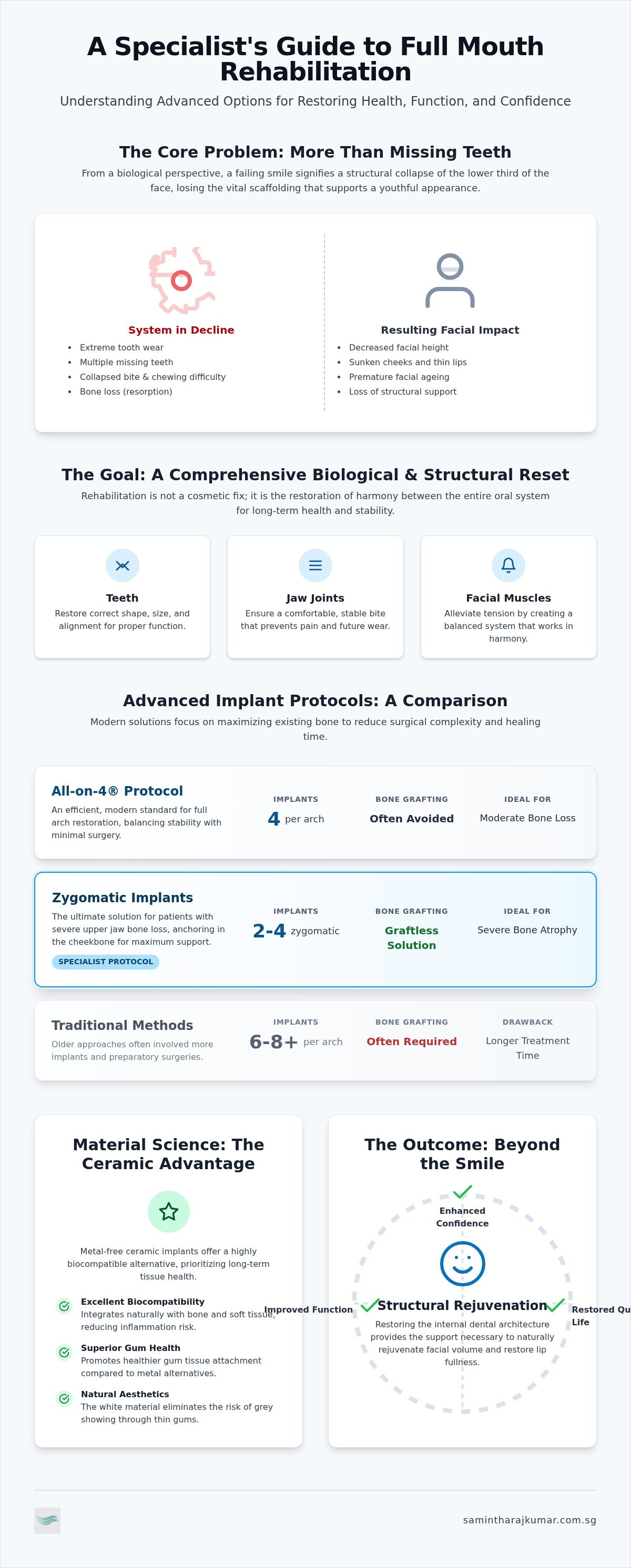
Most patients view a failing smile as a purely dental issue, but from a biological perspective, it's often a structural collapse of the lower third of the face. When you lose teeth and bone, you don't just lose the ability to chew; you lose the scaffolding that supports your facial volume and youthful appearance. I've seen many individuals arrive at my clinic feeling exhausted by conflicting advice and the persistent fear that any surgical intervention might eventually fail. It's a heavy burden to carry when you're simply seeking a permanent, functional solution that feels natural.
In this guide, I'll provide a specialist's clarity on the full mouth rehabilitation options singapore offers in 2026. We'll move beyond traditional methods to explore how AI-assisted diagnostics and advanced surgical pathways, such as zygomatic implants or metal-free ceramic solutions, can restore both your health and your confidence. My goal is to help you understand the science of comprehensive restoration so you can move from a place of anxiety to a future of functional excellence. We'll examine the latest clinical protocols and the long-term impact these biological reconstructions have on your quality of life.
Table of Contents
The Scope of Total Oral Rehabilitation: More Than a New Smile
When I consult with patients regarding full mouth rehabilitation, I often find they equate the process with a simple cosmetic makeover. However, as a clinician and founder, I view this procedure as a comprehensive biological and structural reset. It isn't just about the aesthetics of the teeth; it's about restoring the fundamental architecture of the lower face. Rehabilitation is the restoration of harmony between the teeth, jaw joints, and facial muscles. This harmony is essential for long-term comfort and the prevention of future dental failure.
In my clinical experience, the triggers for seeking full mouth rehabilitation options singapore are usually profound. We often see patients presenting with extreme tooth wear, multiple missing units, or collapsed bites that have made chewing painful and speech difficult. From a biological perspective, these aren't isolated dental issues but symptoms of a system in decline. We must address the systemic health of the mouth, including gum vitality and bone quality, to ensure any restorative work lasts a lifetime.
To better understand how this transformative journey unfolds for a patient, watch this helpful video:
Why the Structural Foundation Matters
The health of your smile depends on the alveolar bone. When teeth are lost, the bone that once supported them begins to resorb or shrink. This loss of density creates a "collapsed" look, where the distance between the nose and chin decreases, leading to premature facial ageing and the appearance of sunken cheeks. By choosing the right surgical pathways, we can achieve structural rejuvenation. We don't just replace teeth; we provide the internal support necessary to maintain a youthful facial volume and prevent further bone loss. It's a transformative process that goes far deeper than the surface.
The Specialist Advantage in Singapore
Complex cases involving significant bone loss or systemic health considerations require an oral and maxillofacial surgeon's perspective. It's about safety and predictability. At Nuffield Dental, we utilise advanced diagnostics, including CBCT scans and AI-assisted mapping, to visualise the surgical site in three dimensions before we even begin. This precision allows us to identify the best bone sites for implants, even in challenging cases where other providers might hesitate. This level of planning is what defines a specialist’s perspective on total oral rehabilitation. We leave nothing to chance, ensuring the foundation is secure before we build the final smile.
Advanced Implant Protocols: Comparing All-on-4 and Zygomatic Solutions
In my clinical experience, selecting the right surgical protocol is the most critical decision in the restorative journey. While traditional implant-supported bridges often require six to eight implants and extensive bone grafting, modern full mouth rehabilitation options singapore have evolved toward more efficient, biomechanically sound solutions. We now focus on protocols that maximise existing bone, reducing both surgical complexity and the overall time to final restoration. Choosing between these pathways depends entirely on the biological landscape of your jaw and your long-term functional goals.
A central pillar of this evolution is the Teeth in a Day procedure. This approach allows us to provide patients with a fixed, functional set of teeth within a single day. This immediate loading protocol isn't just a matter of convenience; it significantly improves the patient's psychological well-being and nutritional intake during the healing phase. However, reaching this stage requires comprehensive treatment planning to determine which implant architecture best suits your individual biological foundation.
The All-on-4 Treatment Concept
The All-on-4 protocol is designed to circumvent the need for bone grafting by tilting the posterior implants at a 45-degree angle. This technique utilises the denser bone available in the anterior part of the jaw. By doing so, we create a stable "table" for the prosthetic bridge. I've seen this transition from failing teeth to a fixed prosthesis occur in under 24 hours, with clinical success rates consistently exceeding 95%. It's a predictable solution for those with moderate bone loss who desire a rapid return to function without the prolonged healing times associated with traditional grafting.
Zygomatic Implants for Complex Bone Loss
For patients who have suffered severe upper jaw bone loss, traditional implants or even All-on-4 may not be viable. In these instances, Zygomatic and Pterygoid implants represent the "gold standard." These specialised implants are longer and are anchored in the cheekbone (zygoma) or the pterygoid plate rather than the jawbone itself. This approach effectively eliminates the need for invasive sinus lifts or months of bone grafting, which can often be a barrier for patients seeking total restoration.
From a biological perspective, the zygoma provides incredibly stable cortical bone, allowing for immediate loading even in the most challenging cases. I often recommend this for patients who have been told by other dentists that they aren't candidates for implants. It's rewarding to offer a solution where others see a dead end. The right diagnosis changes everything.
Material Science: The Case for Ceramic and Biocompatible Options
In my clinical experience, the longevity of a restoration depends as much on the materials used as the surgical skill applied. While titanium has served as the industry standard for decades, the evolution of material science has introduced full mouth rehabilitation options singapore patients now prefer for their superior biocompatibility. Specifically, the shift toward ceramic dental implants represents a move toward biological dentistry, where we prioritise how the body responds to foreign materials over the long term. As a clinician and founder, I've seen that the choice of material is often the deciding factor in how naturally the final result integrates with the patient's existing anatomy.
From a biological perspective, metal-free solutions are more than just a cosmetic preference. Titanium, while generally well-tolerated, can occasionally lead to metal sensitivities or minor corrosion in the oral environment. Ceramic, or zirconia, is entirely inert. This means it doesn't corrode and it doesn't trigger the same inflammatory responses in the soft tissue. For patients seeking a holistic approach to their health, this is a significant advantage. It allows us to rebuild the mouth without introducing metallic elements into the systemic environment.
Ceramic Dental Implants and Biological Dentistry
Zirconia is inherently hypoallergenic and highly biocompatible. One of its most impressive clinical traits is its resistance to bacterial adhesion. Plaque simply doesn't accumulate on ceramic surfaces with the same intensity as it does on metal. This leads to healthier soft tissue and a reduced risk of peri-implantitis, which is the primary cause of implant failure. When we integrate these biological principles into a full mouth reconstruction, we aren't just building a smile; we're creating an environment where the gums can thrive. This is essential for maintaining a healthy, stable gum line that doesn't recede over time.
Functional Aesthetics with Zirconia Crowns
Modern zirconia restorations offer a unique combination of strength and translucency. In the past, ceramic was often seen as brittle, but today's high-performance zirconia can easily withstand the significant forces of the jaw muscles. This is crucial for full-arch cases where functional durability is non-negotiable. It also ensures a superior aesthetic outcome. Because there is no metal substructure, you'll never see that unsightly grey line at the gum margin often associated with older porcelain-fused-to-metal crowns. This allows for a smile that remains vibrant and natural-looking for years. The best outcomes begin with understanding the root cause and choosing materials that align with your body's natural chemistry.
My Perspective: A Decision Framework for Complex Cases
As a clinician and founder, I've spent years refining how we approach the most challenging restorative cases. I believe that truly understanding the full mouth rehabilitation options singapore provides requires a structured decision-making process that looks beyond the surface. In my clinical experience, many patients come to me after years of "patchwork" dentistry. They've had individual crowns and fillings that eventually fail because the underlying system is broken. My philosophy is to prioritise the root cause. This means addressing why the teeth failed in the first place, whether it's due to a collapsed bite, systemic health issues, or structural bone loss.
My 2026 decision framework follows a logical progression: Bone Volume, Biological Preference, and Functional Needs. We first determine the foundation. If bone is scarce, we look at zygomatic protocols. Then, we consider biological preferences, such as the desire for metal-free ceramic implants. Finally, we design for functional needs, ensuring the prosthesis can withstand daily use. We use AI-assisted diagnostics to predict how these variables interact. This technology allows us to simulate the surgical outcome before the first incision is made, ensuring that the plan we create is both predictable and safe.
While the "Teeth in a Day" protocol is transformative, I sometimes recommend a phased approach for specific biotypes. If the bone quality is compromised or the soft tissue needs time to mature, waiting ensures the long-term stability of the restoration. It's a balance between surgical speed and biological reality. Rushing a complex case can compromise the legacy of the treatment, and I always prioritise the patient's long-term well-being over immediate results.
Assessing Candidacy for Total Rehabilitation
When does a patient move from simple repairs to full rehabilitation? It happens when the existing dental units can no longer support a stable bite. We must evaluate the health of the temporomandibular joint (TMJ) because a new set of teeth on a dysfunctional joint will eventually fail. This is why we measure bite alignment with digital precision. We ensure the new structure supports the facial muscles correctly, preventing future pain and wear. A meticulous assessment is the only way to guarantee a permanent result.
The Surgeon’s Philosophy on Innovation
Innovation isn't just about the latest tools. It's about a commitment to global protocols and international surgical standards. I align Nuffield Dental with these benchmarks to ensure our patients receive world-tier care. There's a delicate balance between surgical speed and biological healing. From a biological perspective, the body needs time to integrate new materials. My goal is to be an innovator who respects the natural healing process. The best outcomes begin with understanding the root cause. If you're ready to explore a permanent solution, you can learn more about our specialist-led approach to complex dental surgery.
Beyond the Mouth: Structural Rejuvenation and Quality of Life
In my clinical experience, the most profound transformation a patient undergoes isn't just the ability to chew again. It's the restoration of their facial identity. When we discuss full mouth rehabilitation options singapore, we must look beyond the teeth to the underlying skeletal support. From a biological perspective, the teeth and alveolar bone provide the essential scaffolding for the lower third of the face. Without this support, the distance between the nose and chin collapses, leading to the premature appearance of deep folds and sunken cheeks. By focusing on preventing facial collapse with dental implants, we aren't just performing surgery; we're performing structural rejuvenation.
This structural reset has a direct impact on lip fullness and facial harmony. When the dental arch is properly reconstructed, it provides the necessary projection for the lips, often removing the need for external fillers or more invasive cosmetic procedures. The emotional cadence of this journey is remarkable. Patients frequently arrive with deep-seated anxiety about their appearance and function. As we progress through the stages of structural renewal, that anxiety is replaced by a renewed sense of social confidence. The long-term impact on quality of life is significant, spanning from improved nutritional intake to absolute clarity in speech. It's about giving a patient back their voice and their presence in the world.
Restoring Facial Volume and Harmony
A reconstructed bite acts as a permanent scaffold for facial soft tissues. In many of my complex cases, I observe a synergy between oral surgery and non-surgical aesthetic treatments. Once the dental foundation is secure, the skin and muscles of the face drape more naturally over the new architecture. This prevents the "sunken" look that often accompanies long-term tooth loss. We aim for a result that looks entirely natural, ensuring that the new dental structure complements the patient's unique facial proportions. This holistic approach is what distinguishes specialist-led full mouth rehabilitation options singapore from standard restorative care.
The Future of Care: A Nation-Building Perspective
As a clinician and founder, my vision extends beyond individual consultations. I'm committed to building a healthcare ecosystem in Singapore where high-standard specialist care is accessible and predictable. This involves maintaining an ethical scale, where we expand the Nuffield Dental network without ever compromising on the meticulous quality our patients expect. I believe in healthcare innovation that serves the community, moving toward a future where advanced diagnostics and biological dentistry are the norm rather than the exception. The right diagnosis changes everything for a patient's future. It's about creating a legacy of health that allows every individual to age with dignity and functional excellence. The best outcomes begin with understanding the root cause.
Reclaiming Your Structural Health and Vitality
Choosing to restore your oral health is a decision that impacts your systemic well-being and facial identity for decades. Modern dentistry has moved beyond simple repairs toward comprehensive biological resets. By utilising advanced AI diagnostics and specialist protocols like zygomatic or ceramic implants, we can now provide predictable outcomes for even the most complex cases. These full mouth rehabilitation options singapore offers in 2026 ensure that bone loss is no longer a barrier to a functional, youthful smile.
As a clinician and founder, I'm dedicated to providing a pathway that prioritises your long-term health through meticulous planning and global surgical standards. The right diagnosis changes everything. Whether you seek metal-free solutions or structural rejuvenation of the lower face, the journey starts with a precise understanding of your unique biological needs. The best outcomes begin with understanding the root cause. Explore our approach to total rehabilitation. You don't have to navigate this transition alone; expert care is here to guide you toward a future of renewed confidence.
Frequently Asked Questions
How long does a full mouth rehabilitation procedure take in Singapore?
The timeline for full mouth rehabilitation options singapore patients experience varies based on the surgical protocol selected. For those suitable for the All-on-4 treatment, we can often provide a functional set of teeth within 24 hours. However, complex cases requiring zygomatic implants or extensive biological healing may involve a phased approach over several months. This ensures the implants fully integrate with the bone before the final, permanent prosthesis is fitted for long-term stability.
Am I a candidate for full mouth rehabilitation if I have severe bone loss?
Severe bone loss doesn't automatically disqualify you from treatment. In my clinical experience, many patients told they aren't candidates for traditional implants can still achieve total restoration through zygomatic or pterygoid protocols. These specialised implants anchor into the denser bone of the cheekbone, bypassing the need for months of invasive bone grafting. We use AI-assisted diagnostics to map these bone sites precisely, ensuring a predictable surgical outcome even in the most challenging biological conditions.
What is the difference between All-on-4 and Zygomatic implants?
The primary difference lies in the anatomical anchor point. All-on-4 utilises four tilted implants placed within the jawbone itself, making it ideal for moderate bone loss. Zygomatic implants are longer and anchor into the zygoma, or cheekbone, which provides incredibly stable support when the upper jawbone has significantly resorbed. As a clinician and founder, I recommend zygomatic solutions as the gold standard for severe cases where traditional jaw-based implants simply cannot provide a secure foundation.
Can I use Medisave for full mouth rehabilitation surgery in Singapore?
Yes, you can utilise Medisave for the surgical portion of your treatment. According to Ministry of Health guidelines in 2026, patients can claim between S$450 and S$2,150 per implant fixture for the surgical placement and associated bone grafting. It's important to understand that Medisave does not cover the prosthetic components, such as the final crowns or bridges. My team helps patients navigate these claims to ensure they maximise their available healthcare support for the surgery.
Are ceramic dental implants better than titanium for full mouth cases?
Ceramic dental implants offer distinct biological advantages for certain biotypes. From a biological perspective, zirconia is entirely inert and hypoallergenic, meaning it won't corrode or trigger metal sensitivities. It also resists plaque accumulation more effectively than titanium, which promotes healthier gum tissue and reduces the risk of inflammation around the implant. While titanium remains a durable standard, ceramic is often the preferred choice for patients seeking a metal-free, highly biocompatible solution for their oral health.
Is full mouth rehabilitation painful, and what are the sedation options?
Modern surgical techniques and sedation options ensure the process is remarkably comfortable. We typically perform complex rehabilitations under IV sedation, which is monitored by a specialist anaesthetist. This allows you to remain in a deeply relaxed, sleep-like state throughout the procedure, effectively removing both physical discomfort and surgical anxiety. Most patients report only mild soreness in the days following surgery, which is easily managed with prescribed medication as the biological healing process begins.
How do I maintain my new smile after total oral rehabilitation?
Maintaining your restoration involves a combination of meticulous home care and professional monitoring. You'll need to use a water flosser and specific interdental brushes to keep the area around the implants clean. Regular check-ups at Nuffield Dental are essential so we can monitor the health of the supporting bone and soft tissue. In my clinical experience, patients who adhere to a consistent maintenance programme enjoy their new smile for a lifetime, as the implants remain structurally secure.
What happens if I delay full mouth rehabilitation?
Delaying treatment often leads to progressive alveolar bone resorption and further structural decline. When bone is lost, the lower third of the face begins to collapse, resulting in a sunken appearance and deeper facial wrinkles. Additionally, missing teeth cause the remaining units to shift, which further destabilises the bite and can lead to chronic TMJ pain. From a biological perspective, addressing the root cause early preserves your remaining bone and simplifies the eventual rehabilitation process.


Comments