
Morning Headaches from Jaw Clenching: A Specialist Surgeon’s Guide to Myth-Busting and Relief
- Dr Samintharaj Kumar

- Jun 16
- 12 min read
What if the debilitating pain you feel upon waking isn't a "head" problem at all, but a signal that your masticatory system is under significant structural duress? If you find yourself reaching for analgesics before you've even finished your first cup of tea, you're certainly not alone. Many of my patients describe a cycle of chronic exhaustion and a frustrating inability to open their mouths comfortably, often assuming that stress is the only culprit. While tension plays a role, my clinical experience shows that morning headaches from jaw clenching are frequently rooted in complex biological imbalances; these require more than just a standard mouthguard to resolve.
In this guide, I want to move beyond the myths and look at the science of why this happens and why it matters for your long-term health. We'll examine the structural causes of your discomfort and how a precise, rehabilitative approach to jaw health can restore your quality of life. By understanding the root cause, we can move away from temporary fixes and toward a future where you wake up feeling truly refreshed and pain-free.
Key Takeaways
Shift your perspective from viewing pain as a simple symptom of stress to identifying it as a structural failure of the masticatory system.
Learn why standard mouthguards often act as a temporary bandage rather than a rehabilitative solution for chronic jaw tension.
Gain insight into how I use AI-assisted diagnostics and digital scans to create a precise, biological roadmap for your recovery.
Discover the clinical differences between standard migraines and morning headaches from jaw clenching to ensure you seek the right specialist care.
Understand my philosophy of total jaw rehabilitation, which focuses on restoring facial harmony and lasting functional excellence.
Table of Contents
What are Morning Headaches from Jaw Clenching?
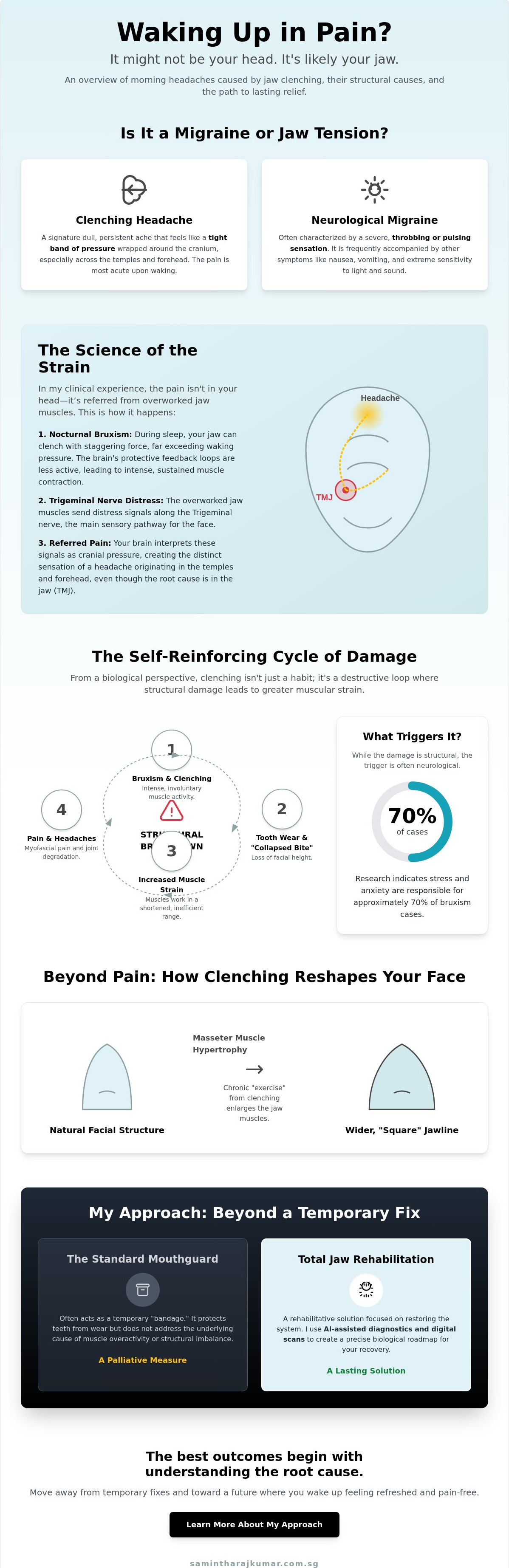
In my clinical experience, patients often misinterpret the source of their discomfort, assuming that a heavy head upon waking is simply a result of poor sleep or general stress. However, when we look closer, we find that morning headaches from jaw clenching are actually a specific physiological response to nocturnal Bruxism. This condition involves the involuntary gnashing or clenching of teeth during the sleep cycle, leading to significant referred pain that manifests as a dull, persistent ache across the temples and forehead.
The signature of this pain is distinct from other neurological conditions. While migraines often involve light sensitivity and throbbing, clenching-related headaches feel like a tight band around the cranium. The Temporomandibular Joint (TMJ) serves as the pivot point for this entire system. When this joint is forced out of its natural alignment by excessive muscle activity, the surrounding tissues become inflamed, creating a cascade of discomfort that is most acute the moment you wake up.
To better understand the relationship between your jaw and these persistent headaches, watch this helpful video:
The Mechanics of Nocturnal Bruxism
From a biological perspective, the force exerted by your jaw muscles during sleep is staggering. The masseter and temporalis muscles, which are responsible for closing the jaw, can exert pressure far exceeding what is possible while you're awake. This happens because the brain's protective feedback loops, which usually prevent us from biting too hard, are less active during certain stages of sleep. These neurological triggers sustain long cycles of clenching, turning what should be a period of rest into a strenuous workout for your facial structure. Over time, this chronic overwork leads to muscle fatigue and structural strain on the dental arches.
Referred Pain: Why Your Head Hurts When Your Jaw Clenches
The reason your head hurts when the problem lies in your jaw is due to the complex wiring of the trigeminal nerve. This nerve is the primary highway for sensory information in the face and head. When the muscles surrounding the TMJ are pushed to their limit, they send distress signals that the brain often interprets as cranial pressure. This is why morning headaches from jaw clenching feel so pervasive. It isn't just one muscle hurting; it's a systemic failure of the masticatory system. By the time you wake, the accumulation of lactic acid and the lack of blood flow to the contracted muscles create that heavy, exhausted sensation that makes starting your day so difficult.
The Science of Jaw Tension and Myofascial Pain
In my clinical experience, jaw tension is rarely an isolated event. It is the visible tip of a much deeper structural iceberg. When the masticatory muscles are perpetually engaged, they undergo a biological transformation that extends far beyond a simple ache. This chronic overwork causes significant changes to the facial complex, often resulting in morning headaches from jaw clenching that feel inescapable. While research indicates that stress and anxiety are responsible for roughly 70% of bruxism cases, the resulting physical damage is what requires clinical intervention to prevent long-term disability.
We must also consider the role of a "collapsed bite." As teeth wear down from the constant symptoms of teeth grinding, the vertical dimension of the face decreases. This loss of height forces the jaw muscles to work in a shortened, less efficient range, which paradoxically increases tension. It's a self-reinforcing cycle where structural dental loss leads to greater muscular strain and, eventually, long-term joint degradation. From a biological perspective, we aren't just treating teeth; we're managing the foundation of your cranial health.
Muscle Hypertrophy and Facial Aesthetics
Chronic clenching doesn't just hurt; it changes the way you look. The masseter muscles, much like any other muscle in the body, grow larger when exercised excessively. This leads to muscle hypertrophy, giving the face a wider, more "square" appearance over time. As a clinician and founder, I look beyond the teeth to the entire facial complex. A square jawline is often a clinical marker of the same underlying tension that triggers morning headaches from jaw clenching. Biological dentistry requires us to address these aesthetic changes as part of a comprehensive rehabilitative plan that restores both form and function.
The Inflammatory Cycle of the TMJ
Every clenching episode causes micro-trauma within the delicate structures of the jaw joint. This inflammation often begins with a subtle "clicking" or "popping" sound when you eat or speak. If left unaddressed, this progression moves toward chronic myofascial pain and restricted movement. Understanding what kind of doctor treats tmj is a critical step in breaking this cycle before it leads to permanent joint wear. A specialist can help you move from managing symptoms to achieving profound personal impact through structural restoration. If you are experiencing these symptoms, exploring specialist TMJ pain management can be the first step toward reclaiming your quality of life. The best outcomes begin with understanding the root cause.
Busting Common Myths About Jaw Clenching and Headaches
In my clinical experience, many patients arrive at my practice feeling defeated by years of following "common knowledge" that simply doesn't work. They have tried the standard advice, yet the morning headaches from jaw clenching persist. To find lasting relief, we must first dismantle the misconceptions that often lead to ineffective treatment pathways.
Myth 1: "A mouthguard will stop me from clenching." This is perhaps the most pervasive error. While a guard protects your teeth from wearing down, it does not necessarily stop the muscular act of clenching itself.
Myth 2: "Morning headaches are just caused by stress." Stress is frequently a trigger, but it is rarely the sole cause. Structural imbalances in the bite or jaw joint often sustain the pain long after the stressor has passed.
Myth 3: "If my teeth don't hurt, I am not clenching." Clenching is primarily a muscular and neurological event. You can experience severe myofascial pain and cranial pressure without ever feeling sensitivity in your teeth.
Myth 4: "Painkillers are a sustainable solution." Analgesics only mask the signal. They do nothing to address the structural failure of the masticatory system that is actually generating the pain.
The Mouthguard Misconception
There is a profound difference between protecting dental enamel and deprogramming overactive muscles. Generic "boil-and-bite" guards can often worsen the situation. Because these materials are often soft or ill-fitting, they can act like a chew toy, actually stimulating the brain to engage the jaw muscles more aggressively during sleep. From a biological perspective, we require specialised orthotics designed to guide the jaw into a neutral, resting position. These clinical devices are built to reduce muscle activity, not just provide a barrier for your teeth.
Stress vs. Structure: The Root Cause Debate
As a clinician and founder, I have seen that while a patient’s life may be stressful, their anatomy is often the true culprit. Many cases of morning headaches from jaw clenching are linked to underlying airway issues or sleep apnoea. When the body struggles to breathe at night, the jaw naturally clenches to keep the airway open. Determining if you are actually suffering from headaches from a jaw issue requires a surgical eye that looks beyond the surface. A comprehensive surgical assessment is essential to identify these anatomical contributors. The right diagnosis changes everything; it allows us to move from managing a "stress habit" to rehabilitating a complex biological system. The path to waking up pain-free starts with looking at the foundation of your facial structure.
Clinical Approaches to Total Jaw Rehabilitation
In my clinical experience, the transition from chronic pain to functional excellence requires a shift from reactive symptom management to proactive structural rehabilitation. We don't simply look for a quick fix; we look for a biological resolution. Resolving morning headaches from jaw clenching begins with a diagnostic journey that leverages the latest in AI-assisted analysis and high-definition digital scans. By moving away from the guesswork of traditional exams, we can pinpoint the exact moment of structural failure within the masticatory system.
True recovery is rarely achieved through a single intervention. It requires a tiered approach that integrates professional surgical insight with dedicated at-home care for tmj pain. While clinical procedures address the underlying anatomy, your daily habits and rehabilitative exercises sustain those results. This synergy ensures that the jaw is not only repaired but also supported by healthy muscular patterns and optimal neurological signaling.
Advanced Diagnostic Protocols
As a clinician and founder, I prioritise the use of 3D Cone Beam Computed Tomography (CBCT) to assess the health of the condyle and the positioning of the articular disc. This imaging allows us to see the joint in three dimensions, revealing micro-trauma or degradation that standard X-rays often miss. We also employ digital tools to measure bite force distribution. By identifying exactly where your teeth meet and with what intensity, we can detect the trigger points responsible for morning headaches from jaw clenching. From a biological perspective, every material we use in this process is selected for its compatibility with your body, ensuring that the final restoration is as healthy as it is functional.
Modern Treatment Modalities
Modern medicine offers sophisticated ways to "reset" the system. For many patients, muscle-relaxing injections into the masseter muscles provide an essential window of relief. These treatments lower the intensity of nocturnal clenching, allowing the muscles to recover from hypertrophy and chronic fatigue. However, we view these as a bridge rather than a final destination. The goal is the transition from managing tmj flare-ups to permanent structural correction through full mouth rehabilitation. By restoring the correct vertical dimension of your bite, we can permanently offload the pressure on the jaw joint. In some complex cases, surgical intervention becomes the most conservative long-term option, as it addresses the root cause directly rather than sentencing a patient to a lifetime of pharmaceutical dependency.
The path to waking up refreshed begins with a precise understanding of your unique anatomy. If you are ready to explore a permanent solution to your facial pain, learn more about our TMJ pain management protocols. The right diagnosis changes everything.
My Perspective: The Future of Facial Pain Management
As a clinician and founder, I have spent my career looking beyond the traditional boundaries of dentistry. In my clinical experience, the jaw is far more than a mechanism for chewing; it is the pivot point of cranial health and the structural foundation of facial harmony. When I see a patient struggling with morning headaches from jaw clenching, I don't see an isolated dental issue. I see a complex biological system that has lost its equilibrium. The future of our field lies in recognising that the mouth, jaw, and cranium are inextricably linked, requiring a holistic, surgical perspective to achieve lasting health.
I believe the intersection of AI-assisted diagnostics and human-centred surgical care represents the next frontier in medicine. By using advanced digital tools to map every nuance of your bite and joint movement, we remove the guesswork that leads to misdiagnosis. This precision allows us to move toward total facial rejuvenation, where we restore not just the teeth, but the entire functional and aesthetic balance of the face. We are moving away from simply "fixing teeth" and toward a model of healthcare that prioritises long-term systemic well-being and profound personal impact.
The Philosophy of Total Rehabilitation
From a biological perspective, treating a symptom like a headache without addressing the underlying structural failure of the jaw is a disservice to the patient. Total rehabilitation means restoring the masticatory system to its ideal state. There is a transformative power in waking up for the first time in years without a sense of exhaustion or pain. It changes your mood, your productivity, and your overall quality of life. My commitment to maintaining global standards in oral and maxillofacial surgery ensures that every patient receives care that is at the cutting edge of international protocols, right here in our practice.
Your Journey to Relief
During a specialist consultation for morning headaches from jaw clenching, you can expect a meticulous evaluation that goes far beyond a cursory exam. We sit down to discuss your history, your pain patterns, and your lifestyle goals. This empathetic, patient-centred approach is essential for managing chronic pain. We use high-tier imaging to look deep into the joint, ensuring we aren't missing the anatomical reality of your condition. It's a partnership based on trust, security, and technical excellence. The path to long-term relief is not found in temporary masks but in a specialist-led plan that respects your unique biology. The right diagnosis changes everything. The best outcomes begin with understanding the root cause.
Reclaiming Your Mornings Through Structural Restoration
We have explored how the journey toward waking up truly refreshed requires a departure from temporary bandages like generic mouthguards. Instead, it demands a sophisticated understanding of your unique biological structure. As a specialist in oral and maxillofacial surgery and the founder of Nuffield Dental, I have dedicated my career to integrating high-tier international protocols with pioneer AI-assisted diagnostics to solve these complex pain puzzles. My goal is to ensure that every patient benefits from a diagnostic process that is as meticulous as it is compassionate.
If you are currently struggling with morning headaches from jaw clenching, remember that this pain is a message from a system under duress; it is not a life sentence. By addressing the root cause through total jaw rehabilitation, we can move beyond symptom management toward true functional excellence and emotional renewal. Waking up without the weight of chronic tension is a transformative experience that restores your focus and your quality of life.
The right diagnosis changes everything. Explore our specialist approach to jaw rehabilitation.
You deserve to start your day with clarity and comfort. The path to a pain-free life begins with a single, precise step toward understanding your anatomy and reclaiming your well-being.
Frequently Asked Questions
Can jaw clenching cause migraines or just tension headaches?
Yes, chronic clenching can trigger full migraines in susceptible individuals, although it most frequently manifests as myofascial tension headaches. The persistent pressure on the trigeminal nerve acts as a neurological catalyst, potentially leading to more severe migraine episodes. In my clinical experience, resolving the underlying jaw tension often reduces the frequency and intensity of these neurological events, as the primary physical trigger is removed.
How do I know if I am clenching my teeth at night if I sleep alone?
You can identify nocturnal clenching by looking for specific clinical markers in the morning. These include a scalloped appearance on the edges of your tongue, unexplained tooth sensitivity, or a stiff, "locked" sensation in your jaw joints upon waking. Unlike grinding, clenching is often silent, so these physical signs are the most reliable indicators of muscular overwork during your sleep cycle.
Will a standard mouthguard from the chemist help my morning headaches?
No, generic "boil-and-bite" guards often worsen the situation by providing a soft, chewy surface that actually stimulates the clenching reflex. To effectively treat morning headaches from jaw clenching, you require a specialist orthotic designed to deprogram the muscles. These clinical devices are precisely calibrated to guide your jaw into a neutral resting position, rather than just providing a soft barrier for your teeth.
Is Botox a permanent solution for jaw clenching and headaches?
Botox is an excellent tool for "resetting" overactive masseter muscles, but it is a temporary intervention rather than a permanent cure. The effects typically last between three and six months. As a clinician and founder, I view muscle-relaxing injections as a valuable window of opportunity. They provide immediate relief while we work on the structural corrections or rehabilitative therapies needed for a long-term resolution.
Can a misaligned bite be the reason I wake up with head pain?
Yes, even a minor bite discrepancy can force your jaw muscles to work overtime to find a stable resting position. This constant search for balance leads to chronic muscle fatigue and inflammation. From a biological perspective, a misaligned bite is a primary structural driver for morning headaches from jaw clenching, as the brain tries to "grind away" the interference during the night.
What happens if I leave my morning headaches and clenching untreated?
Leaving these symptoms unaddressed can lead to permanent joint degradation and significant dental wear. Over time, the constant micro-trauma within the TMJ may result in the thinning of the protective disc or even arthritic changes. This progression makes future rehabilitation more complex, as we move from managing muscle tension to treating irreversible structural damage within the facial skeleton.
How long does it take to see results from specialist jaw rehabilitation?
Many patients report a noticeable reduction in acute pain within the first few weeks of beginning a specialist-led protocol. However, the timeline for total rehabilitation varies depending on the severity of the structural damage. Typically, it takes three to six months to achieve full muscular deprogramming and joint stabilization. The best outcomes begin with understanding the root cause and following a consistent clinical roadmap.
Are there specific exercises I can do at home to stop clenching?
Gentle stretches and "tongue-up, teeth-apart" posture training can help reduce daytime tension and improve awareness. While these exercises are helpful for managing myofascial pain, they are rarely sufficient to stop the powerful, involuntary clenching that occurs during sleep. Professional intervention is usually required to address the neurological and structural triggers that sustain these nocturnal cycles. The right diagnosis changes everything.


Comments