
TMJ Disorder: A Specialist Surgeon’s Perspective on Diagnosis and Total Rehabilitation

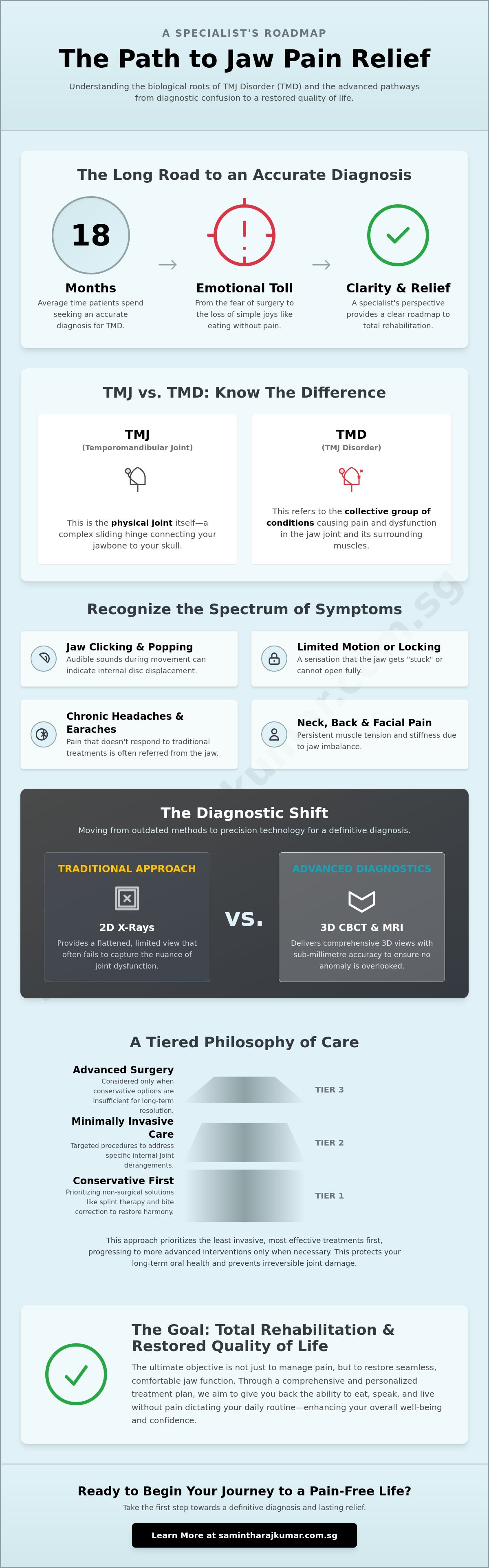
What if the persistent migraines and facial tension you’ve endured for years aren't neurological at all, but a structural failure within your jaw? In my clinical experience, patients often spend an average of 18 months cycling through various practitioners before receiving an accurate diagnosis for tmj disorder. It's a taxing journey of conflicting advice that leaves many feeling hopeless about their recovery. I recognise the daily toll this takes, from the fear of invasive surgery to the simple, stolen joy of a meal without discomfort.
You've likely reached a point where you're seeking more than just another mouthguard or a temporary prescription. This guide offers a specialist surgeon's perspective on the biological roots of jaw pain and the advanced pathways available for long-term relief. I'll outline a clear roadmap for total rehabilitation, explaining how we move from diagnostic confusion to a restored quality of life where pain no longer dictates your daily routine.
Key Takeaways
Understand the biological distinction between the jaw joint and the complex conditions known as tmj disorder to better identify the root cause of your discomfort.
Learn why a technology-driven approach using 3D CBCT and MRI is essential for a precise diagnosis that moves beyond the limitations of traditional X-rays.
Discover how addressing early symptoms like jaw clicking and bruxism can prevent irreversible joint damage and protect your long-term oral health.
Explore a tiered treatment philosophy that prioritises conservative, minimally invasive care—such as splint therapy—before considering advanced surgical interventions.
Gain insight into the transformative journey of total rehabilitation, designed to restore seamless function and enhance your overall quality of life.
Table of Contents Understanding TMJ Disorder: More Than Just Jaw Pain A Biological Perspective on Diagnosis: The Role of Innovation Clinical Consequences: Why Addressing TMD Matters for Total Health My Treatment Philosophy: From Conservative Care to Advanced Surgery My Perspective: Restoring Quality of Life Through Total Rehabilitation
Understanding TMJ Disorder: More Than Just Jaw Pain
In my clinical experience, the temporomandibular joint is one of the most complex structures in the human body. It acts as a sophisticated sliding hinge, connecting your jawbone to your skull and facilitating every word you speak and every bite you take. We must distinguish between the TMJ, which is the physical joint itself, and tmj disorder, which refers to the collective group of conditions causing dysfunction and pain in the jaw joint and surrounding muscles.
Statistics from the National Institute of Dental and Craniofacial Research indicate that between 5% and 12% of adults suffer from these issues, yet it remains a silent burden for many. I often find that a standard dental check-up misses the early signs of joint deterioration. This happens because general dentistry often focuses on the health of the teeth and gums, whereas a specialist perspective is required to evaluate the underlying skeletal and muscular harmony. Without a comprehensive assessment of the joint's mechanics, subtle degradation can progress unnoticed for years.
The Problem: Identifying the Spectrum of Symptoms
Identifying the onset of dysfunction requires a keen clinical eye. While many patients seek help only when pain becomes unbearable, the spectrum of symptoms often begins much earlier. Common indicators include:
Audible clicking or popping sounds during jaw movement.
A limited range of motion or a sensation of the jaw "locking."
Chronic headaches and earaches that don't respond to traditional treatments.
Persistent neck tension and upper back stiffness.
The emotional toll of living with persistent orofacial pain is significant. It's not just about physical discomfort; it's about the erosion of one's quality of life. Chronic pain often leads to sleep disturbances and social anxiety, making total rehabilitation a matter of emotional well-being as much as physical health.
Why It Happens: The Science of Joint Dysfunction
From a biological perspective, tmj disorder arises from a conflict between structural integrity and functional demand. This can range from acute muscular strain to complex physical disc displacement. In my practice, I see that while trauma and arthritis are common culprits, developmental jaw discrepancies play a significant role in long-term wear. When the teeth don't meet correctly, the joint is forced to compensate, leading to premature breakdown of the soft tissues.
Internal derangement of the TMJ is a specific localized condition where the internal joint components, particularly the articular disc, are displaced or damaged, disrupting the smooth mechanics of jaw movement.
As a clinician and founder, I believe that the right diagnosis changes everything. Understanding the root cause is the first step toward a life-changing transformation in oral health.
A Biological Perspective on Diagnosis: The Role of Innovation
In my clinical experience, the most successful outcomes for tmj disorder always begin with a precise, technology-driven diagnosis. I've found that traditional 2D X-rays often fail to capture the nuance of joint dysfunction, as they provide a flattened view of a complex, three-dimensional structure. Instead, I rely on 3D Cone Beam CT (CBCT) and MRI to gain a comprehensive view of the joint's anatomy. These tools allow me to examine the relationship between the condyle and the fossa with sub-millimetre accuracy, ensuring no structural anomaly is overlooked.
As a clinician and founder, I believe that assessing the biological load on the jaw is a critical part of a modern diagnostic protocol. When a patient has missing teeth, the remaining dentition must work significantly harder to process food. This creates a mechanical imbalance that forces the jaw joint to compensate, leading to accelerated wear and inflammation. By identifying these structural gaps early, we can prevent the progression of degenerative changes before they become irreversible. The goal is to move beyond managing pain toward a state of total structural integrity.
AI in Modern Diagnostics
The integration of AI-assisted diagnostics has transformed how I identify minute structural changes in the joint. AI algorithms now help us predict the progression of joint degeneration by comparing a patient's scans against vast databases of clinical outcomes. This technology allows for the precision of digital scanning in mapping jaw movement patterns, highlighting deviations that the human eye might miss during a physical examination. I prioritise objective data over subjective symptom reporting. While a patient’s experience is vital, data doesn't habituate to pain the way a human does, providing a clearer picture of the actual biological state.
The Biological Dentistry Approach
From a biological perspective, oral health is inseparable from systemic wellness. Chronic joint stress triggers inflammatory responses that can resonate throughout the body, affecting everything from posture to sleep quality. I focus on total rehabilitation, where a dental implant singapore can serve as a cornerstone for restoring occlusal balance. Replacing a missing molar can reduce the mechanical pressure on the tmj disorder site by distributing bite forces more evenly. This holistic view ensures that we aren't just treating a symptom but are reinforcing the entire biological system for long-term health. The right diagnosis changes everything.
The best outcomes begin with understanding the root cause.
.
Clinical Consequences: Why Addressing TMD Matters for Total Health
In my clinical experience, many patients dismiss a faint clicking sound in their jaw as a harmless quirk. This is a significant oversight. That clicking often signals the early stages of internal derangement where the articular disc is misaligned. If you ignore these early warnings, the joint can undergo irreversible degenerative changes. Once the protective disc is permanently displaced, bone-on-bone friction begins, leading to osteoarthritis that no longer responds to conservative therapy.
The impact of tmj disorder is rarely confined to the jaw alone. I often describe it to my patients as a "cascade effect." Because the jaw is a primary anchor for the muscles of the head and neck, a structural imbalance here forces the body to compensate. This creates a chain reaction of muscular tension that travels down the cervical spine, affecting your posture and spinal alignment. It's common for a patient to seek my help for jaw pain only to find that their chronic migraines and shoulder tension are symptoms of the same underlying dysfunction.
Bruxism and Sleep Disordered Breathing
From a biological perspective, the relationship between jaw clenching and airway health is one of the most critical areas of modern diagnostics. I frequently find that chronic bruxism is not just a stress response; it's often the body's desperate attempt to keep the airway open during sleep. When the airway collapses, the brain signals the jaw to clench and protrude to restore airflow. This is why I screen a high percentage of my tmj disorder patients for obstructive sleep apnoea. The cycle of poor oxygen intake, increased cortisol, and intense nocturnal grinding creates a state of total physical exhaustion that compromises your long-term well-being.
Facial Aesthetics and Bone Health
Chronic joint dysfunction can lead to visible changes in your facial structure. When the joint is under constant, uneven pressure, it can lead to idiopathic condylar resorption, which is essentially the dissolving of the jawbone. This loss of height in the jaw causes the chin to recede and the facial profile to shift, often resulting in noticeable asymmetry. Early intervention is the only way to preserve the structural integrity of the face.
Bone Preservation: Maintaining the health of the condyles prevents the "collapsed" lower face appearance associated with advanced joint wear.
Strategic Extractions: In my practice, I find that timely wisdom tooth extraction is often necessary to prevent posterior crowding. Removing these teeth can reduce the mechanical stress on the joint and help stabilise the bite.
Soft Tissue Health: Correcting the bite stops the overworking of the masseter muscles, which can otherwise lead to an overly squared, bulky jawline that alters your natural aesthetic.
The goal of total rehabilitation is to stop this progression before it requires major reconstructive surgery. Addressing the root cause today protects your bone health, your sleep quality, and your facial harmony for the decades to come.
My Treatment Philosophy: From Conservative Care to Advanced Surgery
As a clinician and founder, I've always advocated for a tiered philosophy that respects the delicate nature of the temporomandibular joint. My treatment strategy for tmj disorder prioritises minimally invasive care, only escalating to advanced surgery when the biological limits of the joint have been reached. This approach ensures that we don't over-treat, yet don't miss the window for effective intervention. In my clinical experience, approximately 70% of patients find significant relief through a combination of physiotherapy, lifestyle modifications, and precise mechanical therapy.
Splint Therapy and Occlusal Adjustment
The foundation of conservative management often lies in custom-engineered orthotics. Unlike a generic mouthguard found in retail stores, a specialist splint is a precision-engineered diagnostic tool designed to reposition the mandible, whereas a standard night guard is merely a passive barrier intended to prevent tooth wear. We use these orthotics to deprogram the jaw muscles, effectively "resetting" the neuromuscular system to find a neutral, tension-free position. This science-led approach reduces the mechanical load on the retrodiscal tissues, allowing the joint to heal naturally.
Custom Engineering: Every splint is calibrated to the patient's unique bite force and skeletal alignment.
Muscle Deprogramming: We aim to interrupt the cycle of bruxism and clenching that fuels chronic pain.
Long-term Stability: Occlusal adjustments ensure that the teeth meet in a way that supports, rather than stresses, the joint.
Advanced Surgical Interventions
When non-surgical options fail to stop the progression of tmj disorder, we must identify the "point of no return" for joint health. This is where my role as a surgeon becomes central to the rehabilitation process. We might begin with Arthrocentesis or Arthroscopy, which are minimally invasive procedures used to wash out inflammatory mediators and physically reposition a displaced disc. These techniques often provide an immediate reduction in pressure and a significant increase in the range of motion.
For patients experiencing secondary issues, such as gum recession caused by years of malocclusion and jaw tension, I often incorporate Chao Pinhole Surgery to restore the soft tissue architecture. In more complex cases where the underlying issue is skeletal, Orthognathic surgery allows us to correct the jaw structure itself. For end-stage disease where the joint has suffered irreversible damage, total joint replacement remains the ultimate solution for total rehabilitation and a return to a pain-free life.
The path to recovery is built on a foundation of clinical precision and personal care. The best outcomes begin with understanding the root cause of your jaw pain.
My Perspective: Restoring Quality of Life Through Total Rehabilitation
In my clinical experience, the successful resolution of a tmj disorder is one of the most rewarding aspects of maxillofacial surgery. Chronic pain often forces patients to shrink their lives, avoiding social situations or certain foods to manage their discomfort. When we achieve total rehabilitation, we aren't just fixing a joint; we're restoring a patient’s ability to engage with the world with confidence. My philosophy centres on the belief that clinical excellence must be paired with a premium, supportive environment where the patient feels heard and understood.
Modern protocols have evolved significantly over the last decade. We now utilise advanced 3D diagnostic imaging and AI-assisted planning to ensure that our interventions are precise and predictable. This level of precision allows us to achieve results that are designed to last for decades, providing a permanent solution rather than a temporary fix. Selecting the right dental clinic with specialist expertise is vital because TMJ care requires a level of nuance that general practice simply cannot provide.
The Patient Journey and Expectations
Your first specialist consultation with me is a comprehensive evaluation. We'll spend time discussing your history, symptoms, and specific lifestyle factors that contribute to your condition. I view rehabilitation as a deeply collaborative partnership. It involves a coordinated effort between the surgeon, the restorative therapist, and the patient. We follow rigorous international protocols, often drawing from my affiliations with global institutions like the Malo Clinic. My goal is to build a legacy of care through innovation, ensuring every patient benefits from the highest standards of clinical mastery and personal accountability.
The Future Vision of Healthcare
I see the future of TMJ care moving toward bio-regenerative materials. Instead of solely relying on traditional prosthetics, we're exploring scaffolds that encourage the body to repair its own tissues at a cellular level. As a clinician and founder, I'm committed to ensuring Nuffield Dental remains a leader in this evolution across Southeast Asia. We are constantly refining our diagnostic tools and surgical techniques to improve long-term outcomes and minimise recovery times. The best outcomes begin with understanding the root cause.
A Vision for Lasting Jaw Health and Comfort
As a clinician and founder of Nuffield Dental, I've spent my career advocating for the philosophy of total rehabilitation. We've evolved past simple symptom management by integrating AI-assisted dental diagnostics into our standard protocols. This innovation allows us to identify structural abnormalities with a level of precision that was simply unavailable in the early 2000s. My perspective is that effectively managing tmj disorder requires a deep biological understanding of the jaw's relationship with the entire musculoskeletal system.
In my clinical experience, early intervention is vital to prevent the progressive joint wear that affects many long-term patients. Whether your care involves non-invasive splints or advanced Oral & Maxillofacial Surgery, the goal is a seamless return to a life defined by comfort rather than pain. I believe that every patient deserves a treatment strategy that's tailored to their unique physiological needs. By combining international clinical standards with a dedicated patient-centered focus, we achieve results that truly transform your quality of life.
A future free from jaw pain is possible when clinical mastery meets compassionate, individualized care.
Frequently Asked Questions
Is TMJ disorder a permanent condition that I have to live with?
TMJ disorder isn't necessarily a permanent sentence; in my clinical experience, approximately 85% of patients achieve significant relief through non-surgical protocols. While some degenerative conditions require ongoing management, modern total rehabilitation focuses on addressing the root cause rather than just masking symptoms. By combining precise diagnostics with tailored therapy, I aim to restore functional harmony to the jaw, ensuring that long-term discomfort doesn't become a lifelong burden for my patients.
Can TMJ disorder cause permanent changes to my facial appearance?
Untreated jaw issues can lead to visible changes in your facial structure, particularly through masseter hypertrophy where the jaw muscles overdevelop from constant clenching. In advanced cases, joint degradation might cause a shift in the midline of your chin or a noticeable facial asymmetry. My approach involves early intervention to prevent these structural shifts, preserving both the aesthetic balance of the face and the underlying biological health of the joint.
How do I know if my headaches are actually caused by a TMJ issue?
You can often distinguish TMJ-related headaches by their location in the temples and their tendency to be most intense upon waking. Unlike typical migraines, these are frequently accompanied by jaw clicking or restricted movement. During a consultation at Nuffield Dental, I use digital diagnostics to confirm if your headaches stem from muscular tension or joint displacement, as approximately 70% of chronic tension-type headaches have a primary or secondary link to jaw dysfunction.
Is surgery always required for someone diagnosed with TMJ disorder?
Surgery is rarely the first step, as I typically reserve surgical intervention for fewer than 5% of patients with severe internal derangement or joint ankylosis. Most individuals find success through a tiered approach involving custom orthotics, physiotherapy, or biological treatments to reduce inflammation. My philosophy is to exhaust all conservative pathways first, ensuring that we only move toward complex procedures when the biological necessity is clear and the patient's quality of life demands it.
What is the difference between TMJ and TMD in clinical terms?
The term TMJ refers strictly to the temporomandibular joint itself, which is the anatomical structure connecting your jaw to your skull. In contrast, TMD stands for temporomandibular disorder, representing the actual pathological condition or dysfunction affecting that joint and its associated muscles. While people often use the terms interchangeably, as a clinician, I focus on diagnosing the specific TMD subtype to create a precise rehabilitation plan for the tmj disorder impacting your daily comfort.
Can missing teeth or poor dental work lead to TMJ pain over time?
Missing posterior teeth or ill-fitting dental restorations frequently destabilise the bite, placing an uneven biological load on the jaw joints. When you lose even one molar, the remaining teeth must compensate, which can shift the mandible into an unnatural position. In my practice, I often see that total rehabilitation through dental implants or corrected prosthetics is essential to re-establish a stable occlusion and alleviate the resulting strain on the neuromuscular system.
What happens if I choose to leave my TMJ disorder untreated?
Ignoring a persistent tmj disorder can lead to irreversible damage, including the perforation of the articular disc or the development of osteoarthritis within the joint. Over time, chronic inflammation may cause the bone to wear down, leading to a permanent change in your bite and significant dietary restrictions. Early diagnosis is vital because preventing joint degradation is far more predictable than attempting to reconstruct a severely damaged joint after years of neglect.
How does stress contribute to the biological load on my jaw joint?
Stress acts as a primary catalyst for bruxism, where the jaw muscles apply up to 250 pounds of pressure during nocturnal grinding. This intense mechanical load strains the ligaments and compresses the joint space, leading to the inflammation I see in many professional patients. From a biological perspective, managing the psychological load is just as important as the physical treatment, as high cortisol levels can further impede the body's natural ability to repair joint tissues. The best outcomes begin with understanding the root cause.


Comments